Showing posts with label packet. Show all posts

February 23, 2009

Steamboat To Clarksville and Other Boats On Ten Mile Creek

There are a few documented instances of steamboats on Ten Mile Creek. The month of July in the year 1888 saw what was one of the biggest floods ever on the Monongahela. At Brownsville in that year the river crested at 43 feet, the all-time high water mark there. This was three feet more than even the great flood of 1936. On the crest of this 1888 flood the sternwheel towboat WILLIAM WAGNER ran up Ten Mile Creek and landed at Clarksville. The boat was built at Pittsburgh in 1882 and was 100 x 17 x 2 feet. This was a good sized boat, much bigger than the few steam yacht / pleasure boats that are known to have travelled up our creek. There would have been no bridges to deal with at that time until they reached Clarksville, a little less than three miles from the river. Judging by the configuration of the creek it must have been some hard shoving once up to the area where Pitt Gas and Besco would later be. The vessel was owned By Capt. J. C. Cooper ( called Clinton by his friends ) and Levi Barker. Capt Cooper was in command on this trip. What business they had there, if they had a barge in tow or where at the town they landed is unknown. At that time some towboats running in backwater trades also carried a limited number of passengers, even a small 60 foot boat could be registered for 5 cabin and 5 deck passengers. It is possible too, that they did it just for bragging rights as that was sometimes done by these early rivermen. According To Capt. Way's Steam Towboat Directory the boat was " principally remembered as towing timber out of the Upper Monongahela to boatyards and elsewhere." She was out of documentation ( no longer operating ) in 1890. No photographs of her exist. Capt. Cooper's daughter, Mrs. Phil Kussart, is the author of a river history book titled " The Allegheny River . "

Another boat that visited Clarksville on a flood was the little steam propeller yacht GAZELLE. Nothing is known of either her business or the year she went up. She was 65 x 10 x 3 and built by R. C. Price at Allegheny ( now the North Side of Pittsburgh ) Pa. in 1901. At that time she was owned By Harrison P. Dilworth and other Greene County businessmen who had coal properties on the upper Monongahela. On the trip to Clarksville she was under the command of Capt. John S. Faddis who was, I believe, from the Rices Landing area. He was a riverman of some versatility. In 1905 Capt. Faddis was Master of the ROSE HITE, a large ( 155 x 28 x 4 ) Mon river packet boat that ran the upper Mon. He was at the wheel when she collided with the towboat JOHN F. KUEN above Brownsville and sank with the loss of 5 Black deckhands. He also ran the small DAISEY, a " daylight short trader " , between Martin Pa. and Morgantown early in the century. She was a little sternwheel packet , 75 x 14 x 2 with one boiler that was 54" x 7 feet, built at Antiquity Pa. in 1903. Originally built by Capt. E. E. Varian, she was later owned by H.E. and T. B. Eberhart. In 1908 she was sold to Capt. William Goudy of Rices landing and in 1911 she was sold down the Ohio River. No photo known to me exists of this boat. The GAZELLE probably looked somewhat like the HAZEL L. WATSON in the picture below.


This photo shows the little propeller steamer HAZEL L. WATSON running between East Millsboro and Millsboro with the Mouth of Ten Mile Creek in the background. This photo was taken after 1907 since we see the RR bridge across the creek's mouth. This is an old real photo post card view that I bought years ago and likely one of a kind as those often are. The writer of this card describes it as "the ferry", more accurate would be the old term packet boat or the modern term water taxi. It is likely to assume that she made occasional trips into Ten Mile, water permitting. She was built at Allegheny Pa. in 1901 and was 70 x 10 x 3. Owned by Capt. John O. Watson in 1907, Capt. William Syphers of Rices landing bought part interest and owned her outright by 1909. Syphers, who owned the Monongahela Hotel in Rices Landing, ran her between Brownsville and Rices Landing. Later owned by Crosan Construction of Brownsville , she was lost on Feb. 10, 1918 in the big ice of that year , at Rices Landing.
Ten Mile Creek did, and still does put out quite a volume of water. In old times before the new locks a bar would build up running across the river at the creek's mouth and had to be regularly dredged so that boat traffic could pass up and down.

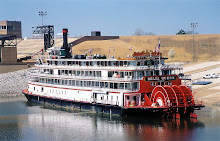
One more steamboat that has a direct connection to Ten Mile is the CLAIRTON. She was built at Ambridge Pa. in 1927 and was 147 x 33 x 6. Originally the called YOUGHIOGENY for Carnegie Steel she was later named the B. F. FAIRLESS. She came to be called CLAIRTON in 1952, being the third and last boat of that name. She ran almost entirely on the Mon till 1964 and was laid up at / near Engles Boat Docks at the mouth of the creek at Millsboro. There was hope she could be utilized locally as a museum but this never came about. While she was laid up there she had a new career as a restaurant for several years. With my family I took a few meals on that old boat . I remember that it was none too fancy but quite clean, everything wood painted white, inside and out. Guests had to ascend to the boiler ( second ) deck for seating in a small saloon. I prowled around her several times on those visits and I fail to remember her having her wheel , it may have been removed. A final chapter to the story is that in 1974 she was sold to a New Orleans company. Her engines , less boilers, were installed in the NATCHEZ, a sternwheel steamboat built new in 1975 for the day excursion trade and those same engines power her in New Orleans Harbor to this day, every day. Some old boats never die.


The CLAIRTON when she was still the B. F. FAIRLESS at the Elizabeth bridge in 1950, shoving coal as she did for 37 years.

January 4, 2009

The Monongahela River Packet Co. And A Race On The River


This is the steam packet boat ELIZABETH at Fredericktown in 1902. She was 188 feet x 35 x 5.5 and was built at Brownsville ( the hull was built at Belle Vernon ) in 1888 for the Pittsburgh - Elizabeth Pa. trade. This trade died out by 1900, no doubt because the railroad by that time went as far upriver as Brownsville. It would be 7 more years till the rails reached any farther south on the west bank. This made the Ten Mile Creek Country trade above Brownsville worth pursuing. In 1902 an independent line was formed called the Monongahela River Packet Company and ran the ELIZABETH under that flag as far upriver as Morgantown. This put her in competition with boats of the Pittsburgh Brownsville and Geneva Packet Company , the oldest and biggest company on the upper river.
In August of 1902 she and the rival company's Str. I. C. WOODWARD met below old lock # 9 and raced each other to the chamber to be the first to lock through. They must have been pretty evenly matched because they arrived at the same time , both becoming wedged in the mouth of the lock and neither could or would move for the other. Here they sat for a while until the Masters of the vessels were called and the issue resolved .


The race resulted in a tie

Which won the race is unknown but in the end the smaller company lost out to the bigger in the trade. 1902 saw the end of the Monongahela River Packet company. She was laid up later that year and in 1903 was sold and moored in the Allegheny river above Pittsburgh's 6th street bridge. In 1904 the boat next to her , the OLIVETTE , caught fire setting the ELIZABETH ablaze. She was turned loose, drifted under the Union bridge , a covered wooden structure and set it on fire . She was then pushed to the bank "where she burned at leisure".

Fire was a big enemy of these large wooden structures, dried wood, countless coats of flammable paint ( anyone who has ever worked on any riverboat, of wood or steel, can tell you that the paint is applied at every opportunity ) , kerosene lamps ( until the 1890's ) , coal or coal oil stoves, strong winds often present on the river, all made it a real possibility. Most cities had large wharf front fires at different times that would destroy many boats at once. Other very real dangers were snags ( sunken trees poking into the hull, causing some boats to sink in less than a minute ) and other sunken obstructions, boiler explosions, groundings and Pilot errors. Most all were heavily insured so when for instance, the Str. NEW ERA was sunk then usually out came the NEW ERA # 2 in a few months. Even if a boat was lost due to fire, boiler explosion or sinking, the steam engine would always be salvaged. They seem to have been virtually indestructible and were often used in several different boats over many years. Some boats lasted 20 years and many just a few years. Packet boats ran year round and tended to wear out quicker than the bigger line haul towboats which ran somewhat seasonally.

Here's the ELIZABETH at Brownsville rounding to with her stacks knocked back to clear the wooden covered bridge there. On the left descending bank is the Str. EDGAR CHERRY, a packet that ran for several years between Pittsburgh and Morgantown until she hit the gates at old lock # 4 and sunk in 1904. One can see the front end of a packet boat on the Brownsville (left) side, this is the OLIVETTE, the boat that would two years later cause the fiery destruction of the Elizabeth in Pittsburgh ( see above ) .


Here she is in the 1890's, possibly at McKeesport, Pa. It must have been some kind of holiday.


Another boat running in this trade for the Mon River Packet Company was the Str. GERTRUDE. She was fancier than most Mon River packets, with a huge pilot house not often seen up here. She was built at Hawesville Ky. in 1895 and ran on the lower Ohio before she came to the Monongahela River in 1902. Before going into the trade she was given new floors and staterooms were added. She was also given a Texas ( small deck of cabins under the Pilot house ) so likely the pilot house was altered then. The big stage seen here was likely left off as they were not much used on the Monongahela. With our steep banks a plank seems to have been sufficient for most landings, and many of the towns had stone or brick wharfs or small floating wharfboats for packets to land on. In 1903 GERTRUDE too, was sold and later ran on the Chattahoochie River in Georgia.

Str. GERTRUDE on lower Ohio 1900.

Information for this was taken mostly from Ways Packet Directory, 1848 - 1994 by Fred Way Jr. Some images are from a great site about the Elizabeth Marine Ways that includes much detail about many Mon river and Mon river built boats, Steamboat Building in Elizabeth, PA . This wonderful site is maintained by Jay W. Mohney and his efforts are a priceless addition to river knowledge.

November 26, 2008

Steamboat Gallery # 1

No steamboats ran regularly on Ten Mile but they ran right past and besides that ........ I love a steamboat. For about 80 years the easiest and cheapest way to get from Ten Mile Country to the big city ( Brownsville or Pittsburgh ) was to take the packet boat. There were actually only two choices, a mud road or the packet boat until the railroad was extended from Brownsville through Fredericktown to Rices Landing ( completed Jan.9,1908 ) and the branch to Besco, in late 1907. Many towboats and packets were seen every day from the banks and people knew them even at night by the distinctive sound of the whistle.
Here are just a few vessels that were very well known to people on our stretch of the Mon.

The Clyde Coal Co.'s very pretty towboat. Imaginatively, she was named CLYDE
. This company had the mine of the same name in Fredericktown. Built at Rochester in 1903, she ran the Mon until 1930.


The Str. JAMES E. LOSE was one of many Carnegie Illinois Steel Co. boats. Later, these boats that ran locally (in the pools between the dams) were called pool boats , were operated under the U S Steel name and the " line haul boats ", which ran down the Ohio and Mississippi Rivers became Ohio Barge Line ( 1941- 1985). When I started at OBL in the mid 1970's many of the Mates, Pilots and Captains that I worked with had been deckhands and Mates on these Carnegie Steel boats.
In 1945 there were as many steam sternwheel boats operating as there were diesel boats. In 1949 there were still 42 sternwheelers ( J&L alone had eleven of them ) running on the Allegheny Mon and upper Ohio. By 1953 there were 10, five owned by US Steel, Consol Coal and Crucible each still operated two and Ohio Barge Line still had one sternwheeler working. OBL 's last steamboat, a steam propeller vessel, ran until 1963. History is not that far behind us, just look over your shoulder and there it is.


This is the Str. La BELLE of the Wheeling Steel Corp. downbound at Fredericktown.


The CHARLES R. COX of US Steel downbound at Rices Landing. Her roof bell is now on display at the Monongahela River Buffs Museum


The Str. ADAM JACOBS at Brownsville in 1895. Owned by the Pittsburgh Brownsville & Geneva Packet Co. she regularly ran between these places. She was built at Brownsville in 1885.
This was one huge boat, over 200 feet long. Click on the pic and it will enlarge to actual size.......... just kidding.

The W.P.Snyder Jr. at Marietta

Fortunately for us there is a wonderfully preserved example of a Monongahela River towboat at Marietta Ohio. The Str. W.P. SNYDER JR. is docked there at the Ohio River Museum. The museum has a large and fine collection of river artifacts but their jewel is this vessel. She is exactly as she was in the old days and you can wander over her at your own pace and see how they lived and worked on the river on this Carnegie Illinois and later Crucible Steel owned boat. I'm glad they saved one of these unique vessels, she is the only surviving coal-fired, steam-powered sternwheeler towboat in the US not to mention the only pool boat. The smoke stacks on all the pool boats were made to be tilted back to clear low bridges and the pilot house was built on the forward end of the cabin rather than on top of the roof. They evolved to fit the needs of the river and locks in terms of power, size and draft. In the late 70's my wife and I first visited this boat at the museum. When I returned to work I was on the boat with Captain Leon Lyle of Pittsburgh, originally from Paducah, Ky. I had worked with him when he was a mate and he was of the old school and was as good a boatman as could be found on the river and I learned much from him. I was talking about how fascinating it was to visit the SNYDER. he said to me " I know that boat very well, I spent 10 years as Mate on her, just like you are Mate on here for me now. " For a complete description refer to her National Historic Landmark Nomination here.

Starboard Engine


The galley, not a lot of space to prepare food for 12 - 15 people.


The Str. W. P. SNYDER JR. was originally built as the Carnegie Steel Co. towboat W. H. CLINGERMAN in 1918 by Rees of Pittburgh, Pa. In 1938 she was renamed J. L. PERRY and in 1945 she was sold to Crucible Fuel Co. and again renamed as the W. P. SNYDER Jr. She towed coal on the Monongahela river for 35 years until she was laid up on September 23, 1953 at Crucible, Pa. In the summer of 1955 she was given to the Ohio Historical Society for exhibit at the Ohio River Museum of the Sons and Daughters of Pioneer Rivermen in Marietta, Ohio.


November 21, 2008

Rice's Landing


The Str. I.C. WOODWARD, well known Mon River packet at the wharf in 1912

Old Lock #6 at Rices Landing. The original lock was completed in 1856. The Engineers did a major overhaul in 1902 and this image was made after that.


images collection of the author
This is where you will find the W. A. Young & Sons Foundry and Machine Shop. It is a real treasure in this area and everyone should visit it at least once. When I walked in there I felt as though I had just stepped out of a time machine. The W.A. Young Foundry has been called “the greatest find of its type in the nation” by the Smithsonian Institute’s curator emeritus. Built in 1900, this foundry and machine shop cast numerous items from horseshoes to locomotive wheels.

The Str. COLUMBIA downbound at Rices Landing.


Dilworth Mine Tipple at Rices Landing.

The Dilworth Mining Company (1880-1930) was the first major commercial coal mine in Greene County, It was a deep shaft mine and had 190 coke ovens and was located along the river on the northern border of Rice's Landing. Coal and coke were loaded directly into barges from the riverside mine.
In 1914, the Rice's Landing Coal and Coke Company acquired the Dilworth Mine. Within the next few years, the H.C. Frick Coke Company acquired the mine and many of the lots in Rice's Landing including two blocks between Second Street and the ferry landing.It was reopened in 1974 by U.S. Steel, and purchased by Consolidation Coal Co. in 1984.

This opens to a fine large map from Caldwells Atlas of 1876

List Of Business Rices Landing 1876


From The Monongahela Directory of 1859

John Swan tomahawked a claim in 1767 at what is now Rice's Landing. He, Jesse Vanmeter and Thomas Hughes built a fort about a mile south of Rice's Landing in 1768. The patent for the land above the run was given to John Rice and he laid out that part of the town as Newport grew. It was founded in 1780 when John Rice obtained a Virginia certificate for a 389-acre tract of land southeast of Pumpkin Run, then known as Enoch's Run. In 1786, Rice patented the land; and the town of Newport was laid out. Abijeah McClain and Pamela Doughty patented the lands to the northwest of the run where the town of Rice's Landing developed in the early 19th century. When the first post office was set up there it was given the name Rice's Landing. Until 1903, Rice's Landing and Newport remained as separate communities divided by the Cumberland and Jefferson Township line but connected by a covered bridge over Pumpkin Run. A later iron bridge was replaced in 1914 with the extant concrete deck bridge.
Even before improvements were made to the Monongahela River's navigation system, a prosperous packet trade operated on the river. By the 1830s, large keelboats and occasional steamboats docked at Rice's Landing where warehouse space provided storage facilities for goods. From the town's dock, Daniel Montgomery commanded a flatboat that was enrolled at the Pittsburgh Customs House in January of 1832. Joseph Sedgewick and his son, Samuel, were prominent traders who operated small steamboats on the Monongahela River when navigation conditions permitted. Sedgewick owned stores and warehouses at Rice's Landing. Unreliable seasonal navigation on the Monongahela River interfered with steamboat and keelboat travel until the improved canalization of the river by the Monongahela Navigation Company. When the locks were completed in November of 1856, a lock keeper was stationed at Rice's Landing to collect tolls. A ferry operated by the Hughes family crossed the Monongahela River at the north end of town providing access to Fayette County and Brownsville.

Rice's Landing was a key riverport on the Upper Monongahela River and served as the distribution point for all of northeastern Greene County including Waynesburg and Jefferson. By 1859 it was described as a "thriving settlement" owing "its present prosperity to the slackwater and its facilities as a shipping point. " The first telegraph line in Greene County, strung in 1861, ran from Rices Landing to Waynesburg.
During the era when it was a booming river town, lines of horse-drawn wagons and hacks would be strung out along the uphill road as far back as Dry Tavern, while the drivers awaited a turn to unload and reload. It was said that more business was transacted in Rices Landing in one day than transpired in Waynesburg in one week. Rices Landing flourished with two livery stables, cooper shops, blacksmith shops, boot stores, general stores, grist mill, planing mill, a machine shop, stone and pottery works, photo shop, sign painters, millinery shops, dress and hat shop, freight haulers, a greenhouse, a drugstore and three hotels. It is estimated that at one time there were 2,000 residents.


Monongahela House Hotel, undated, courtesy of Brad Kline
The Monongahela Hotel was for a many decades the trading and economic center of Greene and parts of Washington County. It was the place of choice for packet boat men, passengers, drummers (salesmen), traders and travelers of the era. The first floor of the old hotel, fronting on Main Street just opposite the U. S. River Lock No. 6, was for many years known as the Monongahela Commission House, where barrels of salt, sugar, flour were traded for hides, whisky, livestock, etc. Old ledgers kept by Linsey Hughes, a Commission House agent, reveals that almost all transactions were made by the barter system, with goods but not much money changing hands.
The famous lodging and trading place was built in 1840 by a group of influential citizens. Among those believed to have been part owners in the Monongahela House Corporation were Isiah Faddis, who was an early day hotel keeper, and Capt. J. Randolph Hewitt, a Civil War Veteran who operated a dry goods store in the building. In the early 1900's Capt. William Syphers owned the hotel. He also ran a small packet boat, the HAZEL L. WATSON between the town and Brownsville. The last owners were James Walton and Samuel Smith, who was an attorney in Waynesburg. In the fall of 1957 the 20-room, three story building, by then sagging and decrepit, was torn down. Only the steps still remain.


In 1870 local school teacher Isaac Hewitt, Jr. established the Excelsior Pottery Works where he produced gray salt-glazed stoneware distinguished by his "Rice's Landing" trademark. Hewitt's pottery was the most profitable company outside of the Greensboro and New Geneva stoneware center located upstream. The company annually produced 45,000 gallons and employed six workers who operated three wheels. Hewitt marketed part of his merchandise through agents while the remainder was sold from wagons by the proprietor. After a decade of success, production was reduced and the annual value dropped from $6,500 to only $2,000 in 1880. As navigation to the Greensboro and New Geneva pottery centers improved, Hewitt's pottery experienced competition for downriver trade, a factor that was most likely responsible for the pottery's demise around 1885. The pottery was later used as a residence and is still extant.

If you really know Rices Landing then you know just where to roll the car window down and yell " Stovepipe ."

This comment was left on a paranormal website discussing The Rices Landing Stovepipe ghost :
Train Tunnel Legend and locals claim on a rainy night a young boy in the 1800's was driving his horse and buggy over railroad tracks to take a short cut when the train came and collided with the buggy, the boy's head was severed and his body found a piece of stove pipe which it placed where his head would be, now on rainy nights after dark if you walk the tracks and call "Stove Pipe" three times his ghost will appear to you. Below is a follow up comment intended to correct the above statement:
The Stovepipe Ghost is not at the tunnel into Pumpkin Run Park. The train over that tunnel last ran in the 1930's, and nobody could drive a buggy over it because it was too narrow. There is a road called Horse Shoe Bend directly up from the tunnel. In the early 1900's a man was coming down Horse Shoe Bend in his horse & buggy when the buggy overturned and the mans head was cut off by the wheel of his wagon. When some men from town went to retrieve the body they said his neck was so flattened out that it resembled a stove pipe. About a year later, on the same road, a person was traveling by and thought he saw the headless body laying along side the road. Later the myth about Stovepipe began. If you go up Horseshoe Bend and stand at the 'bend' and say 'Stovepipe, Stovepipe, I found your head!' You can hear Stovepipe come up the embankment. The tunnel myth was started by some kids who have no knowledge of the town.
If you go under the tunnel and into Pumpkin Run Park and follow the road back then go across the creek, you will see a pile of cut stones. about 100 years ago there was a town back there called 'Casebear Hollow' and there was a stone quarry, a rock dust mill, as well as 10 houses. The stone quarry is a place where a lot of strange happenings have occurred. Its been said that sometimes you can hear eerie flute notes coming from near the quarry, and rumor has it that there is a flight of stairs that take you under the quarry and there are supposed to be some kind of evil things that live there. Further back in the park is a place called 'Mooney Rocks' where someone fell to their death from them. If you follow the creek you will eventually find yourself near the foundation of an old grist mill where the body of a murdered young girl was found....... How do I know these things? I've lived here for almost 65 years. Just be careful when you come here exploring."


There is a small general site about Rices Landing, I can recommend a page of theirs , one of nice and rare old photos, here.