Showing posts with label Fredericktown. Show all posts

December 1, 2009

Some People Of Ten Mile Creek Country

The East Bethlehem High School football team in 1927


Engineer Harry Wood on Waynesburg & Washington Railroad's # 9684 in 1929. The W & W was a narrow guage railroad, just 3 feet wide, so the engines and cars were all smaller than normal. That accounts for the oversized look of Mr. Wood.


Pat Fagan, UMWA Local 5 President, speaking near Brownsville. He was famed as a highly effective organizer and as a speaker. His father was a leader in the steel strike of 1892.
From Sarah Minerd Potter :
" John Phillip Wunder was born on September 30,1887,and died January 11,1948. He was a miner in Greene, Washington and Somerset counties. He married Sophie Margaret Wunder on January 29,1917. Sophie and her second child died shortly after she was born. My mom was 18 months old. John lost an eye, in the mines or not I don't know.He later became totally blind and I have his Federation of the blind cards dating back to 1938. When he couldn't see to write any more, my mom became his eyes and wrote as he dictated his poems. On the Minerd side we have had 31 deaths over the years in coal mining accidents."
John Philip Wunder in Clarksville

THE COAL MINER

The miners' lot is hard indeed.
His family often are in need
The lack of work and sickness too,
are small to what he must go through.

Few of the public ever know
a miners' risk when he must go,
down in the mines to earn his bread,
with tons of loose rock overhead.

With dim lightof his safety lamp
he works in powder,smoke,and damp,
and wades around in mud and slime'
most breathe foul air till' quitting time

And then a roar a rumbling sound
That shakes the earth for miles around
and from the shaft the flames leap high
and men are left in there to die

The agony of these poor men
can not be described by pen
as maimed and dying they await
the help they know will come to late.

No loving voice to cheer them now
no soft cool hand upon their brow
no arms to hold them as they die
no one to say a last goodbye.

They think of men who lay in pain
a week or more but all in vain
they remember how the men were found
all cold and still way underground.

They think is this to be our fate
why must our suffering be so great
they fold their arms upon their breasts
and let starvation do the rest

Think of the mother of the wife
praying for this miners' life
as hour by hour they stand above
and wait for hope from one they love.

And children cry on mothers knees
bring back my papa will you please?
and strong men turn away in grief
for they can offer no relief.

I think a miners' work is such
that he can not be paid to much,
for work he must do underground
where light of day is never found.

John Phillip Wunder
May 25,1922
photo and statement courtesy of Sarah Minerd Potter. The Minerd family has a most extensive website here


This is the first, second and third grade classes at Millsboro in 1923.


Curley Kensic had a bowling alley in Clarksville's Williamstown section. These early 1950's lady bowlers are from left to right :
Elizabeth Durdines, Dot Redman, Bonnie Conners, Clara Lamo, Dot Makel, Barbara Kolick, Ann Burke Kolick.
Photo courtesy of Elizabeth Durdines Sevec


Reader Judith Watters Adamson writes me to kindly correct the newspaper caption:
"I'm the baby shown in the photo entitled "TINY TORNADO VICTIMS", my name is Judith Watters Adamson. I was 8 months old in that picture. I have an original newspaper with this photo. The newspaper is the Pittsburgh Sun-Telegraph and the date is June 25, 1944. The caption is incorrect and should read:
Mildred Watters (not Helen) of Chartiers Hill holds baby Judith in her arms and watches over her other daughter Helen and little Diane Santucci, all victims of a tornado that struck Chartiers Pa. The Waynesburg hospital was so crowded that children had to double up in hospital beds."
Image courtesy of Ida Mary Workman Haftman
Sharpneck Motors in Rices Landing, Anson Sharpneck is third from the left. Photo courtesy of Brad Kline


Earl King remembers :
My name is Earl J. King, born Crucible, Pa 1929. I was graduated from Jefferson/Morgan High School in 1946. I lived in Rices Landing 1933 to 1959, worked in the Rices Landing National Bank, 1955 to 1959 then came to California. Now retired after 42 years of banking in Cerritos, Ca. (suburb of Los angeles).
I delivered the Pittsburgh Press daily to the Y. A. Young machine shop. Carl Young was a Mail Pouch chewer. At about age 13 or 14 I asked him for a chew of tobacco. He gave it to me and I became deathly ill. I thank him now, because I have never touched tobacco after that lesson. My father purchased a 1929 Essex Coupe from the Sharpneck Motor Company in Rices Landing. The dealership was owned by Anson Sharpneck who walked on a artificial leg. He charged us kids 1 cent to pump up our bicycle tires. He operated the Hudson/Terraplane dealership until early 1943, at which time he sold the business to his chief mechanic, Joseph Clarchick. It then became Clarchick Motor Co. I remember financing Hudson cars at the Rices Landing Bank for Joe Clarchick. The Hudson name disappeared and at my last memory it he sold American Motors Cars under the brand of Nash/Rambler. My last time in Rices Landing was May 2005. At that time the building was still standing and used as a warehouse.
Growing up in Rices Landing I remember the steam boats, W. P. Snyder, Homestead, J. B. Fairless, Vulcan and many more. I now regret that I did not take photos of the old lock #5 and all of the steam boats that traveled the Mon. I was working just across the street in Rices Landing at the bank when the Monongahela Hotel was torn down.
On the Crucible Pa Miners Memorial, the Earl King and Earl J. King listed are my dad and I. My dad was very active in Crucible Local #4721 United Mine Workers of America. As a child I remember Jock Yablonski and William (Billy) Hynes at our house on union business many times.
My grandfather, James Kelley, was killed in a slate fall in Crucible Mine 1927. My mothers brother Charles Kelley worked his entire lifetime at Clyde # 1 mine. He was a pumper at retirement.


This photo of Arthur White was taken at Clyde #1 in Fredericktown just minutes before his fatal accident

Arthur Earskin White was born in 1884 in or near Pittsburgh, the son of George H. and Helen "Ella" (Daugherty) White. He is one of a tragic many people to lose their lives in the coal, coke and steel workplace. As a young man Arthur labored on the railroad and as an electrician. Arthur married Roberta "Berdie" Estlick and by 1920, they lived at the Revere Coke Works near Uniontown, where he was a machinist in the coke plant. In 1930 the family was in Luzerne Township, Fayette County, with Arthur continuing his skill as a coal mine machinist. He played on and managed a baseball team in Hopwood.
Arthur was then employed as a machinist and master mechanic at the W.J. Rainey's Clyde # 1 in Fredericktown, due to his experience and knowledge. He was elected president of the United Mine Workers of America local union No. 688, the second person to hold that office.
In the 1930's W.J.Rainy company was strongly opposed to the fledgling Union. As punishment for his Union activities, specifically insisting the men be paid extra for working underground in water, the company moved Arthur out of the shop to a job at the river tipple. On Thanksgiving Day 1935, he was found badly injured, with a fractured skull, after being knocked into a coal barge. Some believed that coal was dumped on him on purpose by a company stooge. He died a day later at Brownsville General Hospital, at the age of 57. A newspaper article claimed that just prior to his death, Earskin had drawn his first pay in more than a year due to debts he owed to the company store.
His grandson, Lee White, remembers " The explanation given to my Grandmother and her eleven children was that he slipped. My dad believes he was killed on purpose. An interesting side note is that the company paid my grandmother $3,500 to waive her rights to future litigation. That was a lot of money at the time and uncharacteristically generous for a coal company. " His remains were laid to rest in the Hopwood Cemetery, near the final resting place of his grandparents and great grandparents. He had managed the baseball team at Clyde and was a member of the Eagles and the Moose clubs.
Arthur White was also a member of the Minerd family referred to above. A more extensive bio of Arthur is here on the Minerd site.
Clinton V. Lewis was one of seven surviving veterans of the Civil War until his death at age 92 on Nov. 28, 1939. Lewis was born at Ruff Creek but spent most of his life in Lone Pine. He enlisted as a teenager in the 18th Pennsylvania Cavalry in March 1865, near war's end. This photo, from the Harbaugh collection, was taken in 1938 at the G.A.R. encampment in Washington Pa.
Image courtesy of The Picture Box


Dorthea Boyd Johnson and her ( now deceased ) brother Sheldon Boyd at the log Stull house at Clarksville in the early 1950's. Her mothers family lived in this house in the 1920's. The Stull family had property on both sides of the north fork of Ten Mile.


Photo courtesy of Dorthea Boyd Johnson

October 20, 2009

Clarksville Hill School And The Beth Center Schools In 1961-62

Here is the Clarksville Hill School fourth grade class of 1961-62, graduating class of 1969.


Top Row : Steve Markovich, Sandy Strastanko, Larry Durdines
2nd Row : Patty Mark, Pat "Pucky" Danko, Rita Mikolay, Bobby Lockett, Kathy Lewis, Billy Murphy, Janet Miles,
Third Row : Ann Wishart, Bert Kiefer, Minnie Thomas, Kathy Lancaster, Bill Jenaway, Carla Lambert
Fourth Row: Marie Boswell, Ron Stuvek, Hollis Smith, John Venick, Yvonne "Bunny" Willis, Louis Monroe, Claudia Lewis
Fifth Row : Darla Booze, Frank Carrico, Tom Kowalczyk, Marlene Evans

Thanks to reader and classmate Bill Jenaway for providing some names that I could not remember.


The Clarksville Hill school likely early 1960's. Thank you Stanley Fowler for preserving this wonderful photo of my childhood school !

This is a list of all Beth Center officials and teachers by school and town. The schools listed are : Beallsville, Clarksville Hill, B-C High School ( Deemston ) , B-C Junior High ( Centerville ) Deemston, Denbo, Low Hill, Marianna, Richeyville, Union School ( Fredericktown ), Vestaburg and West Bethlehem ( Marianna ).


October 19, 2009

Ten Mile Trivia # 4


Shriver covered bridge and Greene County ABATE riders. photo courtesy of Greene County Tourism

Have you ever wondered why were there were so many wooden covered bridges ? And why especially in Pennsylvania and the U.S. Northeast ? In the 1800's, the northeastern United States was a country in need of bridges. It is a fairly narrow coastal plain cut by many short rivers and creeks. Inland farmers needed overland transport, and that meant fords for crossing these streams. But the water-powered mills sought out the very places where streams could not be forded, the falls and rapids. So bridges were needed. The American northeast was forest country, wood was a plentiful building material, especially in the remote areas where the smaller bridges were needed. The climate favored wooden construction. The climate here is harsh by European standards, hot in the summer and icy in the winter, with a freeze-thaw cycle that would overturn stone pavings. Oddly, this sort of climate is less destructive of wood than the mild, moist climate of Britain (or Oregon). Still, wooden bridges tended to deteriorate rapidly from exposure to the elements, having a useful lifespan of only about nine years. Covering them protected their structural members, thus extending their life to 80 years or more. So wooden covered bridges were the answer.The first covered bridge in the nation was built in Pennsylvania in about 1800 over the Schuylkill River in Philadelphia, shortly after a patent for the type of structure was granted in 1797.

.During the first half of the 19th century, Washington and Greene counties were in the heart of an area considered to be the nation's wool growing capital. In 1836, when 50 cents a pound was paid for wool, there were about 200,000 sheep yielding about 500,000 pounds of wool annually there. However, the price declined to about 25 cents a pound by 1842, and the farmers here began to abandon the raising of sheep for more remunerative pursuits.

In 1820, Washington was the most populous community after Pittsburgh in Southwestern Pennsylvania, with 1,687 inhabitants. Uniontown was next with 1,058, followed by Brownsville 976, Greensburg 771, and Connellsville 600.

Opera House Theater in Waynesburg
The Odd Fellows and Masonic Building Association" built in the three-story brick building in 1871, was known as the Town Hall, but later changed to the Waynesburg Opera House in 1889 after its first major renovation. The Opera House hosted a variety of traveling theatrical troupes, as well as lectures from famed orator William Jennings Bryan, known for his involvement in the 1925 Scopes trial, and former President Howard Taft.

In addition to the Opera House, motion pictures could also be seen in Waynesburg at the Eclipse Theater. In Mt. Morris was the Star Theater, the  Ross Theatre was in Carmichaels, Luvland Theater in Rices Landing, the Grand in Clarksville and at the Grand and Milfred theaters in Fredericktown. The coal companys operated their own movie houses in the patch towns of Crucible, Nemacolin, Mather, Vestaburg, Richeyville and Poland Mines.

In 1917, those interested could play pool or billiards at facilities owned by G. W. Hewitt & Sons and Geoge Ritchie in Carmichaels; by C. A. Bernnett in Clarksville; by H. E. Davis in Jefferson; and by J. E. Morris in Mt. Morris. There were five Waynesburg establishments; the Park Billiard Room, the Downey Hotel, and pool rooms operated by Filby & Becler, William Lockard and P. A. Wilbert.


The first golf course in Ten Mile Creek country was laid out by the Greene County Country Club, organized in the fall of 1921. By the end of the year, the County purchased (at a cost of $17,565) almost eighty-eight acres of the Charles C. Harry farm which lay beside Ruff Creek in Morgan Township, about five miles east of Waynesburg along the newly completed concrete road to Jefferson. There it began to lay out a nine-hole golf course that was designed by John McGlynn, "an expert golf course builder," from Pittsburgh. Acquired with the farm was the Harry residence, remodeled as a clubhouse, and a large barn used for equipment storage.


Remains of a Chartiers patch home after the tornado. That is a Model T automobile on it's side to the left. Photo from Stanley Fowler collection.

On the evening of June 23, 1944, three almost-simultaneous tornadoes struck portions of southwestern Pennsylvania, taking 43 lives. Perhaps the most serious of the three came across Washington County from the West Virginia panhandle, moving southeast across northeastern Greene County and the western edge of Fayette. A second touched down in the McKeesport area and moved southeastward past Mt. Pleasant. The third hit Rural Valley in Armstrong County and moved into Indiana.
The towns of Chartiers and Dry Tavern in northwestern Greene County were particularly hard hit. Washington, Brownsville and Greene County hospitals were not only overcrowded by dying and injured but often had to perform operations by light from kerosene lanterns.
Blood plasma was flown from Columbus, Ohio, to Waynesburg by a small plane that landed in a field illuminated by automobile headlights. As word reached points throughout the nation and world, the Red Cross was besieged by inquiries from World War II servicemen concerned about their families back here.

Wind Ridge in Greene County got its name as the result of a coin toss. It originally was known as Jacksonville.
When Greene Co. was still part of Washington Co., Pennsylvania passed an act for the gradual abolition of slavery. At this time there were 155 slave owners in Washington Co. who registered approx. 443 slaves. Of the 443 registered slaves, Greene Countians registered a total of 33 slaves. When the first national censuses were taken in 1790, there were 44 slaves in Greene Co. & 1 free "person of color". In 1800, there were 16 slaves, 23 persons of color living with white, either as servants or family members. In the introduction to Carter G. Woodson's Free Negro Head of Families In The 1830 Census for Greene County, he makes the following notation: "...that year a petition from Greene County said that many Negroes had settled in Pennsylvania and had been able to seduce into marriage "the minor children of White inhabitants." This county, therefore, asked these marriages be made an offence against the laws of the State."


From 1852 through the mid-1930's, the Greene County Agricultural Society held a fair each year in Carmichaels, PA. The original site was on the east side of town where Cumberland Village is located today. Around 1900, the fair was moved to the location on Ceylon Road where Wana B Park is now. According to a book published by Carmichaels Bi-Centennial, Inc. (1967), the main exhibits at the fair in those days were farm products, livestock and manufactured goods. Activities and contests consisted mostly of horse and bicycle races. Entertainment included live bands as a major attraction, and sometimes circus like performers such as tightrope walkers and acrobats. Admission to the fair started out at 15 cents for children and 35 cents for adults. By the 1920's those rates had raised to 50 and 75 cents, respectively. The grandstand seated nearly 2,000 people. The fair closed in 1935 due to a decrease in attendance and "other contributing factors which caused a decline and complete collapse of the Greene County Agricultural Society."
There was also a fair in Jefferson until 1907. The location of the Jefferson Fair is still referred to as "The Fairgrounds". Today the area consists of residential lots.


Jollytown, in Greene County, did not get its name from the jovial atmosphere there, but from pioneer landowner Titus Jolly.

From The Charleroi Mail of June 29, 1911 :
The first work done by the Crucible Coal Company towards the opening of the mine on its property above Rices Landing was begun this week. Several Italian laborers arrived and were put to work constructing a road from the river to the Fordyce, Crago and the Norman Riggle farms. It is on these two farms where the houses of the company will be built. The coal company will build the tipple on the Thomas Crago tract and it will be constructed so that barges in the river can be loaded and also freight cars be shipped by rail. The company will install a ferry across the river as the material, much of it at least, will be shipped by rail and will arrive on the opposite side of the river.
The new works are to be located about one and one-half miles above the lock at Rices Landing.


From The Argus of May 8, 1884:
A. H. Swan, of Cheyenne, Wyoming Territory, is a native of Greene County, Pa., which place he left for the West in 1853, when twenty-two years of age, with $1,000 in his pocket. He now controls more cattle than any other individual on the continent. His present possessions are valued at between $2,000,000 and $3,000,000, while the amount of stock of which he has the exclusive control and management is over 200,000 head, and valued at over $6,000,000. He was the organizer, and is President and General Manager of no less than five different stock organizations in Wyoming.


From unknown newspaper May 29, 1908 :In the marriage of Miss Flora E. Gruber of Greensboro and John Sharpnack last week, an unusual courtship was brought to a fitting climax. John is an employee of the United States government on the new lock at North Charleroi. On February 15, 1906, he picked up a floating bottle, which contained a note signed in a delicate hand. "Miss Flora E. Gruber, Greensboro, Pa., February 14 - St. Valentine's Day - 1906. Finder please write." The river at that time was at high stage, and the missive was not long in finding its way down to lock No. 4, where it was found by Sharpnack. The same evening he wrote a letter, and in due time received a reply. Letters and photographs were exchanged later. The sequel was the marriage last week. The young pair will live at Charleroi.

Albert Bushnell Hart, one of the most famous of American historians, was born in Clarksville Pa.on July 1, 1854. He was a graduate of Harvard, and received numerous honorary degrees. He was a professor of various subjects at Harvard and was later professor emeritus. He was a member and historian of the U. S. Commission for Celebration of the Two Hundredth Anniversary of the Birth of George Washington. He served as joint editor of the Harvard Graduates' Magazine, and also a member of many political and historical associations. Some of Professor Hart's publications are Guide to the Study of American History, Slavery and Abolition, Southern South, Handbook of the War, Causes of the War.

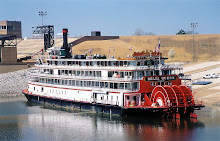
Fredericktown ferry FREDERICK glides back to the east shore of the Monongahela River on March 7, 2006. The ferry rides on cables that are attached to each bank of the river and moves between Fredericktown and LaBelle, Pa. Mile 64.1. Photo by Eric M. Johnson.


As late as the end of World War II, nine ferries on the Monongahela River connected Washington and Greene county points with Fayette County. The communities were Fayette City, Coal Center / Newell, Fredericktown / East Fredericktown ( LaBelle ) , Millsboro / East Millsboro, Crucible / Arensburg, Adah, Nemacolin / Huron, Martin and Greensboro / New Geneva. Since the early 1900's, as the railroad advanced up the river, many people used the ferry to cross to the to the Fayette county side to take the railroad to Brownsville or Morgantown. The Monongahela Railway obligingly built stations or shelters at each ferry landing. In 1950, railroad passenger service along that side of the river between Brownsville and Fairmont, W.Va., came to an end.
The ferry at Fredericktown is the last on the river. I plan to do a story on it but it will be a sad one because it does not seem to have much time left due to the new bridge being built at Denbo. There's been a ferry at Fredericktown since 1790. Thats a long time.

From an unknown local paper, June 1,1891 :
Beckie Brown, the ferryman of Brown's Ferry, near Carmichaels, who died recently, had worked that ferry forty years single handed and alone. She was the widow of James Brown, who died before the Civil war, and Beckie continued to placidly work at the ferry. In her early days she attended all the fairs, horse races and old time musters, peddling gingerbread and spruce beer that she made herself. She had a secret preparation for her gingerbread that made it famous, and no doubt did a great deal toward making it familiar at all the local fairs. She never told her secret to anyone, and with Beckie died the gingerbread reciepe.


From The Charleroi Mail, April 27, 1909 :
Judge James Ingram yesterday refused licenses to all of the Greene county distilleries, the applicants being U. E. Lippincott of Lippincotts, R. W. Higginbotham of Grays Landing, and Gilpin South of Bald Hill. The Waynesburg Brewing Company, which constructed the only brewery in the county, was refused license last week. No retail liquor license has been granted in the county for 31 years. A century ago Greene county had nearly one hundred registered distilleries. The map is now pure white.

The above was taken from various sources including The Greensaver, G.Wayne Smith's History and others.

October 13, 2009

1939 Aerial Survey Photos - Mouth Of Ten Mile To Waynesburg


A reader sent me a link to a most interesting site called Penn Pilot - Historical Aerial Photographs Of Pennsylvania. It seems that on several occasions the entire state was photographed from the air for geological survey research purposes. Different groups of images were made from the 1930's through the 1970's. They are reproduced on a Penn State University website. Shown here are a group featuring Ten Mile Creek from the mouth at Millsboro to Waynesburg in 1939. If you want even closer views, go to the site itself, download the largest versions of the ones you want, if you use Windows , view them then in Windows Media. They open to very large photos : bridges, farms , coal mines , towns, steamboats on the river, to me it's fascinating stuff. In the future, I plan to take a closer look at some of these images and describe what I notice of their content.

The mouth of Ten Mile showing Fredericktown, Millsboro, Besco and Pitt Gas


Clarksville To Chartiers


Pollocks Mill, Jefferson and Mather


Waynesburg and east


September 14, 2009

The 1944 Emerald Mine Fire At Chartiers

It was a spark from a grounded trolley wire that started the Emerald Mine fire soon after seven pm on the evening of June 7, 1944. It fell into a load of hay, fodder for the horses that pulled the pitwagons. There was an attempt to push the burning car into a worked out section but the fire got out of hand and started burning the haulageway. The volunteer fire departments of East Bethlehem and Jefferson arrived as men women and children swarmed down the hill from the patch to see about husbands and fathers. East Beth Fire Chief Albie Tinelli sent four volunteers down the 400 foot shaft with hose but they had to return, the bottom was a raging inferno. Of the 157 men on the night shift all but 6 came out within a few hours, most of them by way of the Lippencott air shaft three miles away. Rescue crews from Tower Hill and Clyde went repeatedly into the mine but the flames drove them back. At the main shaft the women of Chartiers organized a canteen and were passing out coffee to the men as they worked.Mine rescue team of the 1940's
All the local mine officials were on hand, Thomas Lamb, superintendent of the Chartiers pit of Emerald, William G. Stevenson, general manager of the Hillman Coke Company, T.P. Latta, superintendent of Crucibile Steel's Monongahela River Mine, George O'Brian, superintendent of the mines at Allison and Tower Hill, Richard Maize, state secretary of mines, district inspectors from Waynesburg, Uniontown and Monongahela City, the Federal Inspector, U.S.Bureau of Mines engineers , William ( Billy ) Hynes, president of District 4 of the United Mine Workers, UMWA International board member Jock Yablonski and other union officials.


Emerald Mine Tipple at Chartiers 1930, looking north, MRy photo

Emerald is a gassy mine and as the flames spread the work became increasingly dangerous. After eighteen hours the state inspectors ordered the sealing of the mine to avoid further loss. If the fire remained unchecked it could start to burn into adjoining mines. Earlier when the Pike Run mine fire got out of control it burned for ten years. The old Coal Hill Mine on the southside of Pittsburgh caught fire in 1765, before they learned about sealing mines, and was still burning in 1820, looking "like the mouth of a volcano".
There was no hope to get the six men and thirty two horses who remained in the pit. Of the missing miners, three were unmarried, one was the father of five children. Another victim, Steve Barnish, a fifty-five year old machine operator, left nine children. Barnish had a home in Chartiers Village on the hill above the mine. Sixteen days after the mine fire a tornado came through, destroying many of the neat white colonial cottages of the patch. Among the dead were Steve Barnish's wife and one of his daughters.
It took twelve hours to seal the slopes and headings. They put in concrete blocks, covered them with a brattice and then plastered over the top. The mine remained sealed all summer and fall. When the mine was sealed, the adjacent Clyde Mines workings were shut down. For a while over 1900 men were idled in the Ten Mile Creek Valley, 640 from Emerald and the rest from the Clydes. By late December it seemed that the fire was out. It was risky to open a sealed mine because even if the fire is out the heat will have cooked a high concentration of firedamp out of the strata and nearly all oxygen would have been consumed. Of four Pa. explosions caused by mine fires, three were from sealed fires opened too soon.
When the inspectors got inside the mine, they found bodies identifiable only by lamp and check tag numbers. They were 2000 feet from the shaft and would have had time to escape through side routes but for some reason did not.
The clean up took several months and after almost a year after the fire, the Emerald mine was back in operation.

Blasting cap token, Emerald Coal and Coke Co., my collection


Tin sign courtesy unknown donor


Emerald's river tipple above the mouth of Ten Mile, on the present river bike trail. MRy photo

Emerald was originally called the Edward Mine and first opened in 1921. It was accessed by three mine shafts, two slope entries, and a bore hole 36 inches in diameter. The Chartiers Slope, Chartiers Fan Shaft, Chartiers Hoisting Shaft, The River Slope, and air vent, and the Lippincott Shaft. Coal was moved to the river tipple and also loaded onto railroad cars at Chartiers. When the 1944 tornado destroyed much of the original patch housing on Chartiers Hill Emerald Coal and Coke built the Burson patch. The Braden patch was another section of company-built housing for employees of the Emerald Mine, and is probably the last coal patch to be constructed in Pennsylvania. It was at that time a Hillman owned mine.
Renamed Gateway in 1963 by a subsidiary of the companies that used its output, this Morgan Township mine closed in 1989.

This Emerald Mine is not to be confused with the currently active Emerald Mine originally operated by RAG-Emerald and opened in 1977 in Franklin Township, Waynesburg Pa. It was first owned by Youngstown Sheet & Tube Co. and has had several owners since.

Much of this is taken from the book Cloud By Day by Muriel Earley Sheppard.

August 24, 2009

About The Dog Labor Photo And A Little More


Here's a little about the image at the top of each page. It is an old undated real photo post card and shows the tipple of a fairly early primitive coal mine. This is the type of mine that was common before the big commercial coal companies came into the area around 1890-1900. Mining coal as a business started as early as 1818 in Fredericktown. This picture likely dates from 1900 or so but the scene would have looked the same at any time from 1820 to the 1920's. The coal wagons are being pulled by large dogs of different breeds. They look to me like a hound of some kind, a Heinz dog and a Labrador . Though worked, these dogs were likely well taken care of, they certainly look healthy. Using dogs instead of mules or horses indicates that the mine is quite a low ( 3-4 feet high ) vein of coal. This type of operation was known as a "dog mine." Those fortunate enough to have a much taller seam of coal on their property would have used mules or horses. A gentleman who seems to be quite well fed stands at attention in the foreground, likely the owner / operator. It's a wonderful image of early labor, showing the miners posing with their cap lamps and tools and the teamsters waiting to load their wagons.
This card was purchased locally some years ago, considering that and looking at the hills in the background I believe this was taken somewhere in Ten Mile Creek Country.

This was a sidebar on the page for several months and when I began to tweak / add to it today I thought it might deserve a post of it's own. It really is a unique image. I searched Google and Bing in vain for another picture of dogs pulling coal wagons. I searched for dog labor, dog coal, dog pulling, dog mine and nothing shows. Even this image does not show, but now that I used all those keywords in the last sentence, it will !

I have recently updated several posts: the Rices Landing one, and the Clarksville Bridges and the Iron Furnace. As I get more photos and information, I will likely add to or modify most every post or even break up some to expand on a subject. For instance, the above Clarksville Bridges and Iron Furnace will become a two separate posts somewhere down the road as the furnace deserves a post of it's own. All the more reason to check back with your favorite ones from time to time.
If you know a little or a lot about some aspect of the area that we all may like to know, please consider sharing it with me. I'd be glad to help you edit or elaborate on it. If any of your old family photos show mines or trains, train stations, boats or old storefronts, bars or hotels, people working or playing, in any Ten Mile towns I would love to see them and share them here. Even if Mamaw or Aunt Eunice is in the foreground it would be of interest. Sometimes the best pictures of a train station are taken on the day Mamaw went to Pittsburgh to get her hip surgery or the day sweet Aunt Eunice and her alcoholic husband finally went back home from their visit.

August 6, 2009

Major Mine Disasters In The Area


Mather Miners Memorial


Robena Monument at Hatfield Ferry

DATE MINE NAME CITY LIVES LOST CAUSE

03-06-02 Catsburg Monongahela, Pa. 5 Explosion
11-21-03 Ferguson Connellsville, PA 17 Explosion
07-06-05 Fuller Searight, PA 6 Explosion
10-10-05 Hazelkirk No. 2 Monongahela, PA 2 Explosion
10-13-05 Clyde Fredericktown, PA 6 Fire
10-29-05 Hazel Kirk No. 2 Monongahela, PA 5 Explosion
11-15-05 Braznell Bentleyville, PA 7 Explosion
12-19-07 Darr Jacobs Creek, PA 239 Explosion
11-28-08 Rachel and Agnes Marianna, PA 154 Explosion
03-22-11 Hazel Canonsburg, PA 9 Haulage
07-30-15 Patterson No. 2 Elizabeth, PA 9 Haulage
03-13-17 Henderson No. 1 Henderson, PA 14 Explosion
06-02-20 Ontario Cokeburg, PA 6 Explosion
02-02-22 Gates No. 2 Gates, PA 25 Explosion
07-25-24 Gates No. 1 Brownsville, PA 10 Explosion
04-02-27 No. 53 Cokeburg, PA 6 Explosion
05-19-28 Mather No. 1 Mather, PA 195 Explosion
06-07-44 Emerald Clarksville, PA 6 Fire
03-12-45 Crucible Crucible, PA 5 Roof/Bump
09-23-57 Marianna No. 58 Marianna, PA 6 Explosion
12-06-62 Robena No. 3 Carmichaels, PA 37 Explosion

11-20-68 No. 9 Farmington W.Va. 78 Explosion
07-22-72 Blacksville No. 1 Blacksville, W. Va. 9 Fire

Consider that these listed are only the major accidents in the area. Many others died daily in the mines. In 1907 Pennsylvania lost 1614 with 5 disasters alone claiming more than 800 men, the other 800 lives were lost in normal day to day operations.
The high death rate among miners was due, not to spectacular gas explosions but to the steady picking off of workers in slate falls. In the entire US, in the thirty three years ending Jan.1,1939, 27,064 men died from slate falls, only 8,045 from explosions - 77 percent as opposed to 23%. The sudden smothering death of one or two miners at a time was so common it rated a couple lines on page two of the newspaper.
"On..........a slate fall cost the life of ........., an employee at the .........'s .......... mine. There will be a High Requiem Mass at St. .......'s Church on the morning of ......... The deceased leaves a wife and ....... children, etc."

Not too far up the Monongahela at Monongah West Virginia was the largest loss of life in any mine in US history , 362 men died after an explosion tore through Monongah # 6 and 8 on December 6, 1907. Not one man that was in the mine came out and lived.


Greene County Monument on Interstate 79.

The text reads :
On December 6, 1962, 460 Feet Directly Beneath This Site, 37 Miners Lost Their Lives In The U.S. Steel Robena Mine's Frosty Run Explosion. One Of The Worst Mine Disasters In Green County History.
The memorial features a likeness of famous mine labor leader John L. Lewis; on the reverse side is a roll of Greene County Miners. President of the United Mine Workers of America (UMWA) from 1920 until 1960 and founding president of the Congress of Industrial Organizations (CIO), John Llewellyn Lewis was the dominant voice shaping the labor movement in the 1930s. The CIO owed its existence in large measure to Lewis, who was a tireless and effective advocate of industrial unionism and of government assistance in organizing basic industry.
The date of dedication was May 26, 1995.


The Coal Miners Memorial at Bethlehem Center High School, Fredericktown, Pa. Not a disaster memorial but a beautiful statue.

April 8, 2009

Ten Mile Trivia # 2

Ten Mile Creek came to be called so because it's mouth is ten miles above Old Redstone Fort at Brownsville. In the early days they named creeks and other landmarks as being so many miles from a known place, as Brownsville certainly was in the early days. Islands also took mile marker names, for instance above Louisville Ky is 18 mile island then 12 mile island and then 6 mile island.
Some think the creek was named so because it's ten miles long. Not true, but ten miles up the creek is located the town of Ten Mile. Its Indian name is Cusuthee.
.
The very first steamboat to travel to New Orleans and return by its own power was the ENTERPRISE, designed and built in the Brownsville boatyards and launched from the Brownsville Wharf in 1814.

"Saint Barbara , the patron saint of miners, was a young virgin who defied her father and decided not to marry. Because of this he kept her in a tower. She ordered some workmen to alter the tower while her father was away, thus becoming the saint of architects. After finding out about this her father chased her to the hills where she was swallowed up by the hill. Her name is attached to Santa Barbara, California. There is a prayer for miners dedicated to Saint Barbara:
"As I now descend into the dark bowels of the earth, I beseech thee, sweet Barbara, that I be kept safe from harm, for it liketh me not that I rush unbidden into God's presence."

Wilson's Port, later called New Geneva was a very early place for freighting flatboats and rafts.The land later was patented by Elias Stone and his wife in 1787 and was called Delight.


Augustine Dillner and his wife were the first settlers in what is now Greene county.They arrived as early as 1754 and in 1755 built a cabin close to Crow's Ferry ( Dillner ). The Indians were friendly with them till Lord Dunmore's war of 1774.


"While making a tour of the United States in 1837, General Santa Anna, President of Mexico, stopped in Washington Pa.on January 15. Following the custom of the time, he probably took breakfast at Hill's Stone Tavern ( now the Century Inn ) in Scenery Hill, Pa. This was only a year after the massacre of the Texans at the battle of the Alamo, and Santa Anna was not very popular, so there was no reception committee. All known of this visit was the mere mention in the local paper, The Examiner of his passing and a well grounded tradition that a local man named Brice, whose brother had drawn a black bean ( died ) at Goliad, lay in wait just west of town to take a pot shot at the self styled "Napoleon of the West" as the stage rolled by. Fortunately for Santa Anna the sheriff heard of the plot, and, probably against his personal inclination, gathered Brice into his official fold until the Mexican was safely through Washington. Incidentally, Brice was a dead shot, and might have saved the United States much trouble nine years later if the sheriff had let him alone."

Hills Tavern now Century Inn


UMWA LOCALS
6330 Chartiers
688 Clyde
4583 Clarksville
6151 Mather
6290 Nemacolin
6310 Greensboro
4731 Crucible

6159 Bobtown
762 Vestaburg
2300 Waynesburg

UMWA Band of 4583 Clarksville Stanley Fowler Collection

One of the most notable early teachers in Fredericktown was Jonathan Knight. He was later one of the most eminent engineers of his day and became Chief Engineer of the Baltimore and Ohio railroad. He was the inventor of the coning of RR car wheels so that cars stationary on their axles can run on curved tracks without spreading the rails. He surveyed a line ( never built) for the B&O through Greene County in 1836. He lived in Centerville Pa.


Augustine Dillner and his wife were the first settlers in what is now Greene county.They arrived as early as 1754 and in 1755 built a cabin close to Crow's Ferry ( Dillner ). The Indians were friendly with them till Lord Dunmore's war of 1774.

In 1826 the Str. REINDEER was the first boat to Morgantown.

"On February 11, 1850, the first steamboat came up the Monongahela River to the little town of Fairmont. This boat was the GLOBE owned by a man named Yeager. Its appearance created a great sensation among the people, for the majority of them had never seen a steamboat, much less had one come up to their very doors. When it became known throughout the country that a steamboat was to come up the Monongahela River at daybreak on February 11, the people for miles around gathered along the banks of the river as early as the afternoon before. When the whistle of the Globe was heard down the river, the courthouse bell was rung for two hours. The people had brought lunches, so they took the day off as a holiday; speeches were made, and the new wonder examined. Many of the citizens had a free ride up the river. That day was long to be remembered." It was two years before another boat arrived.


In 1856 slackwater, meaning locks and dams, were completed up to New Geneva, making navigation possible nearly year round.

Dry Tavern was named so because in early days there was a tavern there with no liquor sold. It was on the main road leading south between Pittsburgh and Virginia. For years it was the busiest north - south road west of the mountains. The road was laid out by John Crawford and went from Pittsburgh to Finleyville, Bentleyville, Beallsville, Millsboro, Charmichaels, Willow Tree, Rosedale to Morgantown. It was planned to be 60 feet wide.

Ruff Creek got it's name from an Indian named Ruff who lived there.

The first telegraph line in Greene county was erected from Rices Landing to Waynesburg in 1861.


Southwest Pennsylvania was claimed by the districts of West Augusta, Virginia and by Westmoreland, Pennsylvania. In 1776 West Augusta became Ohio, Yohogania and Monongalia Counties, in Virginia. . Greene County in 1776 was partly ( the western slope ) in Ohio county Virginia and partly ( the eastern slope ) in Monongalia County Virginia. The court house for Monongalia was near New Geneva Pa. on the farm of Theopolis Phillips. The court house for Ohio county was at West Liberty W. Va. Virginia law directed that at each court house there was to be a pillory, a pair of stocks, a whipping post and a ducking stool ( now called waterboarding ). Only the ducking stool was used for women.
By 1780 Virginia and Pennsylvania settled their boundary dispute placing most of the Yohogania County region in Westmoreland County. In 1781 Washington County was created from Westmoreland County. Greene County was created from Washington County in 1796.


Before the big modern dams you could at times cross the mouth of Ten Mile Creek by skipping from rock to rock. Other times, because of the volume of water coming out of the creek a very large sand bar would build up there and the river channel would have to be dredged for boats to pass.

Besco is named for the Bessemer Coke Company who operated the Champion mine there using all the coal to make coke in it's 100 ovens . By 1914 there were 257 ovens, a sizable operation. The railroad reached Besco around 1911 and that was the end of track until it was extended farther through Clarksville to Mather in 1919.

In Common Pleas Court in 1797, the following case was considered : The Sheriff of Greene County wishes Richard Swan to answer the charge that he bit off a piece of John Moore's ear thereby damaging the peace and dignity of the Commonwealth.

January 4, 2009

The Monongahela River Packet Co. And A Race On The River


This is the steam packet boat ELIZABETH at Fredericktown in 1902. She was 188 feet x 35 x 5.5 and was built at Brownsville ( the hull was built at Belle Vernon ) in 1888 for the Pittsburgh - Elizabeth Pa. trade. This trade died out by 1900, no doubt because the railroad by that time went as far upriver as Brownsville. It would be 7 more years till the rails reached any farther south on the west bank. This made the Ten Mile Creek Country trade above Brownsville worth pursuing. In 1902 an independent line was formed called the Monongahela River Packet Company and ran the ELIZABETH under that flag as far upriver as Morgantown. This put her in competition with boats of the Pittsburgh Brownsville and Geneva Packet Company , the oldest and biggest company on the upper river.
In August of 1902 she and the rival company's Str. I. C. WOODWARD met below old lock # 9 and raced each other to the chamber to be the first to lock through. They must have been pretty evenly matched because they arrived at the same time , both becoming wedged in the mouth of the lock and neither could or would move for the other. Here they sat for a while until the Masters of the vessels were called and the issue resolved .


The race resulted in a tie

Which won the race is unknown but in the end the smaller company lost out to the bigger in the trade. 1902 saw the end of the Monongahela River Packet company. She was laid up later that year and in 1903 was sold and moored in the Allegheny river above Pittsburgh's 6th street bridge. In 1904 the boat next to her , the OLIVETTE , caught fire setting the ELIZABETH ablaze. She was turned loose, drifted under the Union bridge , a covered wooden structure and set it on fire . She was then pushed to the bank "where she burned at leisure".

Fire was a big enemy of these large wooden structures, dried wood, countless coats of flammable paint ( anyone who has ever worked on any riverboat, of wood or steel, can tell you that the paint is applied at every opportunity ) , kerosene lamps ( until the 1890's ) , coal or coal oil stoves, strong winds often present on the river, all made it a real possibility. Most cities had large wharf front fires at different times that would destroy many boats at once. Other very real dangers were snags ( sunken trees poking into the hull, causing some boats to sink in less than a minute ) and other sunken obstructions, boiler explosions, groundings and Pilot errors. Most all were heavily insured so when for instance, the Str. NEW ERA was sunk then usually out came the NEW ERA # 2 in a few months. Even if a boat was lost due to fire, boiler explosion or sinking, the steam engine would always be salvaged. They seem to have been virtually indestructible and were often used in several different boats over many years. Some boats lasted 20 years and many just a few years. Packet boats ran year round and tended to wear out quicker than the bigger line haul towboats which ran somewhat seasonally.

Here's the ELIZABETH at Brownsville rounding to with her stacks knocked back to clear the wooden covered bridge there. On the left descending bank is the Str. EDGAR CHERRY, a packet that ran for several years between Pittsburgh and Morgantown until she hit the gates at old lock # 4 and sunk in 1904. One can see the front end of a packet boat on the Brownsville (left) side, this is the OLIVETTE, the boat that would two years later cause the fiery destruction of the Elizabeth in Pittsburgh ( see above ) .


Here she is in the 1890's, possibly at McKeesport, Pa. It must have been some kind of holiday.


Another boat running in this trade for the Mon River Packet Company was the Str. GERTRUDE. She was fancier than most Mon River packets, with a huge pilot house not often seen up here. She was built at Hawesville Ky. in 1895 and ran on the lower Ohio before she came to the Monongahela River in 1902. Before going into the trade she was given new floors and staterooms were added. She was also given a Texas ( small deck of cabins under the Pilot house ) so likely the pilot house was altered then. The big stage seen here was likely left off as they were not much used on the Monongahela. With our steep banks a plank seems to have been sufficient for most landings, and many of the towns had stone or brick wharfs or small floating wharfboats for packets to land on. In 1903 GERTRUDE too, was sold and later ran on the Chattahoochie River in Georgia.

Str. GERTRUDE on lower Ohio 1900.

Information for this was taken mostly from Ways Packet Directory, 1848 - 1994 by Fred Way Jr. Some images are from a great site about the Elizabeth Marine Ways that includes much detail about many Mon river and Mon river built boats, Steamboat Building in Elizabeth, PA . This wonderful site is maintained by Jay W. Mohney and his efforts are a priceless addition to river knowledge.

December 5, 2008

W.J. Rainey And The Clyde Mines

This is the river tipple at Fredericktown in the late 1920's, looking south. This was the original Clyde mine, opened in 1900.

image from Bower's Fredericktown 1790-1990

Coal came out of this slope portal and went directly to the river tipple as seen in this 1929 photo. Shown are 8-ton gathering locomotives, these gathered the coal cars from various working places in the mine and made up the long trains for the haulage locomotives to pull out of the mine.


The Clyde mines have had several owners over many years. The original ( 1900 ) Clyde Coal Company of Pittsburgh sold their Fredericktown mine to W. J. Rainey of Cleveland, Ohio in 1925. From that point it was a captive mine to Republic Steel. In Pitt Gas, the William Pitt mine had been operating since at least 1916. Owned by the Pitt Gas Coal Company, it was worked by the Trumbull Coal Co. from around 1920. The Rainey company bought it in 1929. They called it Clyde # 2 and enlarged the town of Pitt Gas with the construction of 84 brick and tile houses. The Clarksville Gas Coal Co. operated a mine at Clarksville starting around 1920. At some point in 1925 or later, Rainey bought it and this is what must have become Clyde # 3.
W.J. Rainey, active in the business since the 1880's, owned many large mines. By 1904 he owned 3,200 coke ovens employing 18,00 men. Some of these, with partner T. J. Wood, were operated as the Rainey - Wood Coke Company. Known as the Cleveland Coke King, he was Frick’s main competitor in the Connellsville district. His thousands of acres of coal rights were scattered over the tri-state area . When he died in 1919 he left a fortune worth about 40 million dollars ( equal to half a billion and more in todays dollars ). The company operated under that name for years afterward.


. This porcelain sign likely dates from the Rainey takeover. It's very plain but is one of my most favorite pieces in my modest collection. This is because my father and his father worked together as buddys at # 3 in Clarksville.

So under The Rainey's control, Clyde #1 was at Fredericktown, Clyde #2 was at Pitt Gas, Clyde #3 was at Clarksville. Emerald ( originally Edward Mine, 1921) at Chartiers was called by some Clyde #4 but was since the middle 1920's ( if not always ) owned by the Emerald Coal and Coke Co. ( Hillman ). It seems that Clyde #2 was connected underground with Emerald at least for a time. In 1944 when there was a fire at Emerald ( which took six lives ) causing that mine to be sealed , much of Clyde had to be closed temporarily. In this same year there were about 1260 men employed at the three Clyde mines.
Rainey later ( around 1948 ) sold all these to Hillman Coal and Coke Company. Later they were operated under the name of Republic Steel.
Through this period of time, most commercial coal mines in our area were owned by the same few big dogs, Carnegie, Hillman, Rainey , H.C. Frick, the Jones brothers and a very few others. The Mellons were involved in the Pittsburgh Coal Company and had been working with H.C.Frick since the late 1870's. The names , on paper, moved back and forth over the years. The coal at a certain place was Rainey's , but Emerald mined it, at some point Hillman bought the coal from Rainey, or from Emerald , or whoever, and then Hillman mined it.


Blasting Cap Token From Clyde # 2 in Pitt Gas, my collection


1925 Map from Monongahela Railway 1903-1993, Gratz and Arbogast

Aerial view of Pitt Gas and Clyde # 2. The coal wagons came out of the slope three at a time and crossed the creek on a bridge to where the railcars were loaded. It looks as though the loading of cars here had stopped by the time of this 1939 photo. Gone too, are the railroad yard tracks. The tall concrete pier from the tipple still remains today beside the modern road.


This is Clyde #3 at Clarksville, looking south. The cars are marked for the Rainey-Wood Coke Company in this 1937 photo from the Mononghela Railway.


Aerial view of Clyde # 3 in 1939, tipple and cars underneath, the swinging bridge and the mine shop buildings. The slate dumps are behind the row of miners houses we called Shantytown. A mine track comes out of the tipple and curves around as it crosses over the Besco road and runs to the slate dumps south of the mine. Aerial images courtesy of Penn Pilot.


Clyde # 3 looking west, likely in the 1930's, photo courtesy Of Hoyle Family


2009 image by author

The Clyde # 3 site today, looking west. The swinging bridge is behind the photographer. The above tipple was in the center of this photo. The stables were to the left, near the underpass, against the track embankment. The piece of paved road in the foreground is part of the original road. To the left on this side of the old road were several frame houses that the company built for bachelor miners.


A very partial list of miners who worked in Clyde can be found here.