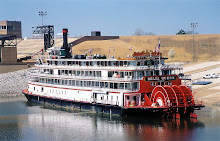
The Str. I.C. WOODWARD, well known Mon River packet at the wharf in 1912
Old Lock #6 at Rices Landing. The original lock was completed in 1856. The Engineers did a major overhaul in 1902 and this image was made after that.

images collection of the author
This is where you will find the W. A. Young & Sons Foundry and Machine Shop.
It is a real treasure in this area and everyone should visit it at least once. When I walked in there I felt as though I had just stepped out of a time machine. The W.A. Young Foundry has been called “the greatest find of its type in the nation” by the Smithsonian Institute’s curator emeritus. Built in 1900, this foundry and machine shop cast numerous items from horseshoes to locomotive wheels.
The Str. COLUMBIA downbound at Rices Landing.
Dilworth Mine Tipple at Rices Landing.
The Dilworth Mining Company (1880-1930) was the first major commercial coal mine in Greene County, It was a deep shaft mine and had 190 coke ovens and was located along the river on the northern border of Rice's Landing. Coal and coke were loaded directly into barges from the riverside mine.
In 1914, the Rice's Landing Coal and Coke Company acquired the Dilworth Mine. Within the next few years, the H.C. Frick Coke Company acquired the mine and many of the lots in Rice's Landing including two blocks between Second Street and the ferry landing.It was reopened in 1974 by U.S. Steel, and purchased by Consolidation Coal Co. in 1984.
This opens to a fine large map from Caldwells Atlas of 1876
List Of Business Rices Landing 1876
From The Monongahela Directory of 1859
John Swan tomahawked a claim in 1767 at what is now Rice's Landing. He, Jesse Vanmeter and Thomas Hughes built a fort about a mile south of Rice's Landing in 1768. The patent for the land above the run was given to John Rice and he laid out that part of the town as Newport grew. It was founded in 1780 when John Rice obtained a Virginia certificate for a 389-acre tract of land southeast of Pumpkin Run, then known as Enoch's Run. In 1786, Rice patented the land; and the town of Newport was laid out. Abijeah McClain and Pamela Doughty patented the lands to the northwest of the run where the town of Rice's Landing developed in the early 19th century. When the first post office was set up there it was given the name Rice's Landing. Until 1903, Rice's Landing and Newport remained as separate communities divided by the Cumberland and Jefferson Township line but connected by a covered bridge over Pumpkin Run. A later iron bridge was replaced in 1914 with the extant concrete deck bridge.
Even before improvements were made to the Monongahela River's navigation system, a prosperous packet trade operated on the river. By the 1830s, large keelboats and occasional steamboats docked at Rice's Landing where warehouse space provided storage facilities for goods. From the town's dock, Daniel Montgomery commanded a flatboat that was enrolled at the Pittsburgh Customs House in January of 1832. Joseph Sedgewick and his son, Samuel, were prominent traders who operated small steamboats on the Monongahela River when navigation conditions permitted. Sedgewick owned stores and warehouses at Rice's Landing. Unreliable seasonal navigation on the Monongahela River interfered with steamboat and keelboat travel until the improved canalization of the river by the Monongahela Navigation Company. When the locks were completed in November of 1856, a lock keeper was stationed at Rice's Landing to collect tolls. A ferry operated by the Hughes family crossed the Monongahela River at the north end of town providing access to Fayette County and Brownsville.
Rice's Landing was a key riverport on the Upper Monongahela River and served as the distribution point for all of northeastern Greene County including Waynesburg and Jefferson. By 1859 it was described as a "thriving settlement" owing "its present prosperity to the slackwater and its facilities as a shipping point. " The first telegraph line in Greene County, strung in 1861, ran from Rices Landing to Waynesburg.
During the era when it was a booming river town, lines of horse-drawn wagons and hacks would be strung out along the uphill road as far back as Dry Tavern, while the drivers awaited a turn to unload and reload. It was said that more business was transacted in Rices Landing in one day than transpired in Waynesburg in one week. Rices Landing flourished with two livery stables, cooper shops, blacksmith shops, boot stores, general stores, grist mill, planing mill, a machine shop, stone and pottery works, photo shop, sign painters, millinery shops, dress and hat shop, freight haulers, a greenhouse, a drugstore and three hotels. It is estimated that at one time there were 2,000 residents.

Monongahela House Hotel, undated, courtesy of Brad Kline
The Monongahela Hotel was for a many decades the trading and economic center of Greene and parts of Washington County. It was the place of choice for packet boat men, passengers, drummers (salesmen), traders and travelers of the era. The first floor of the old hotel, fronting on Main Street just opposite the U. S. River Lock No. 6, was for many years known as the Monongahela Commission House, where barrels of salt, sugar, flour were traded for hides, whisky, livestock, etc. Old ledgers kept by Linsey Hughes, a Commission House agent, reveals that almost all transactions were made by the barter system, with goods but not much money changing hands.
The famous lodging and trading place was built in 1840 by a group of influential citizens. Among those believed to have been part owners in the Monongahela House Corporation were Isiah Faddis, who was an early day hotel keeper, and Capt. J. Randolph Hewitt, a Civil War Veteran who operated a dry goods store in the building. In the early 1900's Capt. William Syphers owned the hotel. He also ran a small packet boat, the HAZEL L. WATSON between the town and Brownsville. The last owners were James Walton and Samuel Smith, who was an attorney in Waynesburg. In the fall of 1957 the 20-room, three story building, by then sagging and decrepit, was torn down. Only the steps still remain.
In 1870 local school teacher Isaac Hewitt, Jr. established the Excelsior Pottery Works where he produced gray salt-glazed stoneware distinguished by his "Rice's Landing" trademark. Hewitt's pottery was the most profitable company outside of the Greensboro and New Geneva stoneware center located upstream. The company annually produced 45,000 gallons and employed six workers who operated three wheels. Hewitt marketed part of his merchandise through agents while the remainder was sold from wagons by the proprietor. After a decade of success, production was reduced and the annual value dropped from $6,500 to only $2,000 in 1880. As navigation to the Greensboro and New Geneva pottery centers improved, Hewitt's pottery experienced competition for downriver trade, a factor that was most likely responsible for the pottery's demise around 1885. The pottery was later used as a residence and is still extant.
If you really know Rices Landing then you know just where to roll the car window down and yell " Stovepipe ."
This comment was left on a paranormal website discussing The Rices Landing Stovepipe ghost :
Train Tunnel Legend and locals claim on a rainy night a young boy in the 1800's was driving his horse and buggy over railroad tracks to take a short cut when the train came and collided with the buggy, the boy's head was severed and his body found a piece of stove pipe which it placed where his head would be, now on rainy nights after dark if you walk the tracks and call "Stove Pipe" three times his ghost will appear to you. Below is a follow up comment intended to correct the above statement:
The Stovepipe Ghost is not at the tunnel into Pumpkin Run Park. The train over that tunnel last ran in the 1930's, and nobody could drive a buggy over it because it was too narrow. There is a road called Horse Shoe Bend directly up from the tunnel. In the early 1900's a man was coming down Horse Shoe Bend in his horse & buggy when the buggy overturned and the mans head was cut off by the wheel of his wagon. When some men from town went to retrieve the body they said his neck was so flattened out that it resembled a stove pipe. About a year later, on the same road, a person was traveling by and thought he saw the headless body laying along side the road. Later the myth about Stovepipe began. If you go up Horseshoe Bend and stand at the 'bend' and say 'Stovepipe, Stovepipe, I found your head!' You can hear Stovepipe come up the embankment. The tunnel myth was started by some kids who have no knowledge of the town.
If you go under the tunnel and into Pumpkin Run Park and follow the road back then go across the creek, you will see a pile of cut stones. about 100 years ago there was a town back there called 'Casebear Hollow' and there was a stone quarry, a rock dust mill, as well as 10 houses. The stone quarry is a place where a lot of strange happenings have occurred. Its been said that sometimes you can hear eerie flute notes coming from near the quarry, and rumor has it that there is a flight of stairs that take you under the quarry and there are supposed to be some kind of evil things that live there. Further back in the park is a place called 'Mooney Rocks' where someone fell to their death from them. If you follow the creek you will eventually find yourself near the foundation of an old grist mill where the body of a murdered young girl was found....... How do I know these things? I've lived here for almost 65 years. Just be careful when you come here exploring."
There is a small general site about Rices Landing, I can recommend a page of theirs , one of nice and rare old photos, here.


 Posts
Posts