Showing posts with label river. Show all posts

October 4, 2009

New Website About The Area - SWPA Rural Exploration


Crucible Ferry area


Levine Building Fire In Rices Landing and that site today
It's nice to welcome a new blog about our neck of the woods. Greene County native Chip Guesman has created a site he calls SWPA Rural Exploration and describes it this way " Exploring and photographing southwestern PA's abandoned mines, industry,homes....and whatever else we may find. A little history, a little legend..... from the most massive structures to the minute details we walk past every day."
He's only had the site going for a short time but there is already a lot of great photographs of things like the coke ovens at Poland Mines, and even a video of the area at Rices Landing where one can find the Stovepipe Ghost. Watch that video to actually see things come running out of the woods ! I felt like I was watching the Blair Witch Project :). Not for the faint hearted !
I am always fascinated with urban and rural archaeological websites and I'm very happy to see one dedicated to this area. I mean heck, we've got at least as much decaying infrastructure right here as one could hope to find anywhere else !


Rices Landing Low water 1980's, All images from SWPA Rural Exploration

September 14, 2009

The 1944 Emerald Mine Fire At Chartiers

It was a spark from a grounded trolley wire that started the Emerald Mine fire soon after seven pm on the evening of June 7, 1944. It fell into a load of hay, fodder for the horses that pulled the pitwagons. There was an attempt to push the burning car into a worked out section but the fire got out of hand and started burning the haulageway. The volunteer fire departments of East Bethlehem and Jefferson arrived as men women and children swarmed down the hill from the patch to see about husbands and fathers. East Beth Fire Chief Albie Tinelli sent four volunteers down the 400 foot shaft with hose but they had to return, the bottom was a raging inferno. Of the 157 men on the night shift all but 6 came out within a few hours, most of them by way of the Lippencott air shaft three miles away. Rescue crews from Tower Hill and Clyde went repeatedly into the mine but the flames drove them back. At the main shaft the women of Chartiers organized a canteen and were passing out coffee to the men as they worked.Mine rescue team of the 1940's
All the local mine officials were on hand, Thomas Lamb, superintendent of the Chartiers pit of Emerald, William G. Stevenson, general manager of the Hillman Coke Company, T.P. Latta, superintendent of Crucibile Steel's Monongahela River Mine, George O'Brian, superintendent of the mines at Allison and Tower Hill, Richard Maize, state secretary of mines, district inspectors from Waynesburg, Uniontown and Monongahela City, the Federal Inspector, U.S.Bureau of Mines engineers , William ( Billy ) Hynes, president of District 4 of the United Mine Workers, UMWA International board member Jock Yablonski and other union officials.


Emerald Mine Tipple at Chartiers 1930, looking north, MRy photo

Emerald is a gassy mine and as the flames spread the work became increasingly dangerous. After eighteen hours the state inspectors ordered the sealing of the mine to avoid further loss. If the fire remained unchecked it could start to burn into adjoining mines. Earlier when the Pike Run mine fire got out of control it burned for ten years. The old Coal Hill Mine on the southside of Pittsburgh caught fire in 1765, before they learned about sealing mines, and was still burning in 1820, looking "like the mouth of a volcano".
There was no hope to get the six men and thirty two horses who remained in the pit. Of the missing miners, three were unmarried, one was the father of five children. Another victim, Steve Barnish, a fifty-five year old machine operator, left nine children. Barnish had a home in Chartiers Village on the hill above the mine. Sixteen days after the mine fire a tornado came through, destroying many of the neat white colonial cottages of the patch. Among the dead were Steve Barnish's wife and one of his daughters.
It took twelve hours to seal the slopes and headings. They put in concrete blocks, covered them with a brattice and then plastered over the top. The mine remained sealed all summer and fall. When the mine was sealed, the adjacent Clyde Mines workings were shut down. For a while over 1900 men were idled in the Ten Mile Creek Valley, 640 from Emerald and the rest from the Clydes. By late December it seemed that the fire was out. It was risky to open a sealed mine because even if the fire is out the heat will have cooked a high concentration of firedamp out of the strata and nearly all oxygen would have been consumed. Of four Pa. explosions caused by mine fires, three were from sealed fires opened too soon.
When the inspectors got inside the mine, they found bodies identifiable only by lamp and check tag numbers. They were 2000 feet from the shaft and would have had time to escape through side routes but for some reason did not.
The clean up took several months and after almost a year after the fire, the Emerald mine was back in operation.

Blasting cap token, Emerald Coal and Coke Co., my collection


Tin sign courtesy unknown donor


Emerald's river tipple above the mouth of Ten Mile, on the present river bike trail. MRy photo

Emerald was originally called the Edward Mine and first opened in 1921. It was accessed by three mine shafts, two slope entries, and a bore hole 36 inches in diameter. The Chartiers Slope, Chartiers Fan Shaft, Chartiers Hoisting Shaft, The River Slope, and air vent, and the Lippincott Shaft. Coal was moved to the river tipple and also loaded onto railroad cars at Chartiers. When the 1944 tornado destroyed much of the original patch housing on Chartiers Hill Emerald Coal and Coke built the Burson patch. The Braden patch was another section of company-built housing for employees of the Emerald Mine, and is probably the last coal patch to be constructed in Pennsylvania. It was at that time a Hillman owned mine.
Renamed Gateway in 1963 by a subsidiary of the companies that used its output, this Morgan Township mine closed in 1989.

This Emerald Mine is not to be confused with the currently active Emerald Mine originally operated by RAG-Emerald and opened in 1977 in Franklin Township, Waynesburg Pa. It was first owned by Youngstown Sheet & Tube Co. and has had several owners since.

Much of this is taken from the book Cloud By Day by Muriel Earley Sheppard.

August 26, 2009

A Look At the Upper Monongahela by Richard Bissell


Brownsville Pa. Looking south

A description of the towns and sights along the Monongahela River from Brownsville to Fairmont in the late 1940s, written by the pilot of the towboat COAL QUEEN:

You would never think, to walk the streets of Brownsville today, that the town is old and filled with history and legend. Monongahela Valley towns just do not look the part as do Lexington and Concord and Portsmouth and Gloucester and Boston and Philadelphia. For famous Redstone Old Fort, now Brownsville, is another "industrial town," and aside from the Greek Revival, postColonial Playford House on Second and Market Streets, little romance is visible.
Colonel James Burd selected the site of Redstone Old Fort in 1758 because of the presence there of an early Indian fortification, and built his stockade. In 1785 Thomas and Basil Brown founded the town, which in the years to follow played an important part in the westward movement. It was at Brownsville that the weary emigrants saw the end of their toilsome struggle over the mountains and took to the calm waters of the Monongahela for the next lap of their journey. As the steamboat rose to fame and fortune on the western waters and industrial activity in the valley grew, the Brownsville-Pittsburgh trade developed. Even before the slack-water system had been completed to Brownsville in 1844, there were about two hundred steamboat arrivals annually at Pittsburgh from upriver points. After the locks and dams went into service, there was a daily packet line between Pittsburgh and Brownsville.
There is an old iron bridge in Brownsville that I inspected one time when we were laid up in drydock out at the Hillman shipyard. This bridge is on Market Street near Bank, and it has a tablet on it which says it is the first iron bridge west of the Alleghenies. It was apparently built in the period 1836-1839 of iron forged in Iocal furnaces. Before this bridge was built, Henry Clay's carriage overturned near this spot, dumping the great man into Dunlap's Creek. They say that Clay "gathered himself up with the remark that Clay and mud should not be mixed in that place again." Clay then returned to Washington to his senator's post and shortly afterwards an order was issued for the construction in Brownsville of an "iron span, carrying the road high above the stream."

Maxwell Lock looking south

After we go under the Brownsville Highway Bridge, height 50.2 feet above low water, span 386 feet, we come to Dam 5, and after locking through, we pass the Alicia Marine Ways of the Hillman Company and then are pretty much out in the country, except for coal mines and tipples at regular intervals. There's Vesta tipple and Frick Mine Light, Fox Mine Light and the H. C. F. Coke Company tipple, Vestaburg and Fredericktown and the bend around to Tenmile Creek, and Emerald Tipple, Pumpkin Run, Klein's Sawmill Light, Crucible Fuel Company tipple, and Light, Weirton Steel Company tipple, National Steel Corporation Pier, Buckeye Coal Company tipple, Browns Run, Little Whiteley Creek, Robena Mine Light and tipple, Pittsburgh Steel tipple, Duquesne Light Company tipple, Jacobs Creek, and then around the bend to Dam 7.


Vesta 5 Tipple looking south

Below Dam 7 are Greensboro on the starboard side, and New Geneva on port. New Geneva boasts a population of 410 souls, more or less, and was named for the native city of its famous early settler, Albert Gallatin. Gallatin came to this country without friends or influence, and by the sheer power of his personality and ability (and despite the handicap of a monumental French accent) achieved appointment as a member of the President's Cabinet within ten years of his arrival. A man of many talents, Gallatin served in the Revolutionary War, then became a French instructor at Harvard. Later he journeyed to Richmond on business and there became an intimate of Governor Patrick Henry, who advised him to go west to the wild lands of opportunity out by the Monongahela. Gallatin settled in Fayette County, a few miles from New Geneva and in a short time established the first glassworks west of the Alleghenies. In 1789 he built Friendship Hill, a 2 1/2-story, ivy-covered residence, still standing and open to the public.He began to enter local politics, filling several state and federal posts, and in 1801 was appointed secretary of the treasury by President Jefferson. He served in this post during both of Jefferson's presidential terms, the.whole of President Madison's first term, and until February, 1814, in the second, something of a record in Cabinet tenure. After retirement from the Cabinet this energetic adopted son of the new Republic held several diplomatic posts and finally, between 1831 and 1839 was president of the National Bank of New York.
Patrick Henry said Albert Gallatin was one of the most extraordinary men he had ever seen. He was surely of keen intellectual powers and magnificent ability in political and diplomatic affairs--the model statesman. At Friendship Hill the dignified retirement of Gallatin was embellished in 1825 by a visit from "his long tried, his bosom friend," the Marquis de Lafayeffe. Of this sumptuous affair an old Monongahelite, James Veech (writing in 1858), said: "Who that was there can ever forget the 'feast of reason'--and other good things, and the 'flow of soul'-and champagne? The like of which old Springhill [Township] had never seen--may never see again."

In the five miles upriver from New Geneva to Point Marion, where the Cheat River enters the Monongahela, no less than five coal tipples are busy dumping Pennsylvania coal into waiting barges. Point Marion has a large glassworks and a sand and gravel company which owns a baby Diesel towboat with a steam boiler for operating the steering rig and blowing the whistle, a quaint arrangement unique in my experience.


Morgantown looking east around 1928

Around a few bends and beyond more tipples, Morgantown rises on the hills to port. Ah, Morgantown, with your glass factories and coal mines and spaghtetti at Capellanti's and houses all peeling from chemical fumes in the air! On Saturday nights in spring the boys and girls from the University of West Virginia, perched up on the hill at the end of Main Street, mingle on the sidewalks down by the courthouse with coal miners and fanners and glassworkers. To us on the Coal Queen, Morgantown was everything, our metropolis--the hot bath, the glass of Tube City beer, the lump-in-throat in the movies, the Girl, paradise, purgatory--we knew them all in Morgantown. But Morgantown knew little of us. Steamboaters, with their excitable and noisy ways, are not invited to tea parties. I can call every bartender and short-order waitress in town by name but the mayor and I have yet to shake hands. Above Morgantown the Monongahela is a beautiful narrow stream running between high hills--"mountains," we always called them. The locks are small, the traffic is light, and there is a friendly intimacy benveen boat crews and lock tenders. The locks are so close that in a six-hour watch you might make seven or eight locks. After a few months of this, running those locks seemed automatic. That's pretty country up in there from Morgantown to National Mine, and pretty again above Jordan, especially in the spring, when the trees and flowers are all in bloom. And then, half blinded sometimes by the smoke from the railroad yard, we come to Fairmont, and beyond it the "Dark Bridge" (no lights on it), which we all hated, and then there was the point, where the Monongahela ended, a point with a big tree on it, a good mark and easy to pick up with the searchlight on a bad night.

The Monongahela is formed by the West Fork River and the Tygart River, which join here at Fairmont, 128.73 miles south of Pittsburgh. The tipple where we loaded coal was at Kingmont, up the Tygart, two miles above head of navigation on the Monongahela, and we would snake our loads out of there in a river so narrow you could nearly jump across.


Now just imagine, in the old days you could take a good big steamboat from Fairmont, West Virginia, at the headwaters of the Monongahela, down to Cairo, up the Mississippi and Missouri to Fort Benton, Mont.--3,623 miles, or about as far as from the North River in New York to the East India Docks on the Thames at London. In fact the stern-wheeler E. H. Durfee made regular trips between Pittsburgh and Fort Benton in the years 1872 to 1876. Wouldn't that be something, to raise steam amidst the roar of industry on the Monongahela and keep that paddle wheel splashing until you began to run into buffalo and Sioux and the Rocky Mountains ?

This is taken from the book The Monongahela by Richard Bissell, part of the Rivers of America series, Rinehart & Co., Inc., New York, 1952, pp. 70-83. He wrote several outstanding books on towboating and the river life. The accounts are gritty and very realistic. He also wrote several successful Broadway plays including The Pajama Game.

July 8, 2009

A Visit To The Monongahela River Buffs Museum

A few weeks ago I had the pleasure to visit the Monongahela River Buffs Association Museum in Monongahela Pa. This group began in the late 1970's at Greensboro Pa ( mile 84 ) by a small group of river enthusiasts headed by Bill Young, Ernie Gabler and Bill Bennett. In 1986 MRBA moved to it's present location in Mon City.


Entrance to the museum, note that the OPEN sign is extended

My son Casey and I were greeted by Dr. J. K. Folmar and Jay Mohney, two of the stalwart members of this group. Dr. Folmar is the author and editor of several books on steamboats, transportation and local history of the upper Mon river valley and is retired from the faculty at nearby California University in California Pa. J.K. is the long time President of the group and the editor of their newsletter THE VOICE OF THE MON. His wit is exceeded only by his knowledge of local river history. Jay's website STEAMBOAT BUILDING IN ELIZABETH PA. a work of many years, is without argument, the most extensive site about steamboating on the internet. These dedicated gentlemen made us feel very comfortable and cheerfully answered any questions we had.


Jay Mohney and Dr. J.K. Folmar


Some house flags from J&L, G&C and US Steel


There is much to see and if your level of interest is like mine you can easily spend a few hours there. There is a large collection of old photos, books and artifacts, most all in a " hands on " environment. Everything here has been donated by local companies and individuals looking to preserve the area's river history.


Large diorama of a keelboat being built on the Mon


Whistle next to the bell of the CHARLES R COX


Several large boat models can be seen at the museum


There is a fine collection of name boards. All photos by Author

The museum is at 175 Second Street, above the Span-Taylor Drug Store and one half block from the river, is open on the second and fourth Saturdays of each month from 1 to 3 Pm. It may also be visited by appointment. Meetings are held on the third Tuesday ( April thru November) at 7:00 pm. Dues for membership are 5.00 per year. The mailing address is Mon River Buffs Assn. PO Box 401, Monongahela Pa. 15063. Contact them by email at
folmar@zoominternet.net. They have a website, now under construction here.
The group, like most local museums, operates on a small budget and donations are very welcome. If you have an interest in the river , or family members who worked on the boats or the locks, as many from Ten Mile Creek Country do, please consider a membership and or a monetary donation to keep this wonderful project going. Join them and help preserve our important local river heritage.

February 23, 2009

Steamboat To Clarksville and Other Boats On Ten Mile Creek

There are a few documented instances of steamboats on Ten Mile Creek. The month of July in the year 1888 saw what was one of the biggest floods ever on the Monongahela. At Brownsville in that year the river crested at 43 feet, the all-time high water mark there. This was three feet more than even the great flood of 1936. On the crest of this 1888 flood the sternwheel towboat WILLIAM WAGNER ran up Ten Mile Creek and landed at Clarksville. The boat was built at Pittsburgh in 1882 and was 100 x 17 x 2 feet. This was a good sized boat, much bigger than the few steam yacht / pleasure boats that are known to have travelled up our creek. There would have been no bridges to deal with at that time until they reached Clarksville, a little less than three miles from the river. Judging by the configuration of the creek it must have been some hard shoving once up to the area where Pitt Gas and Besco would later be. The vessel was owned By Capt. J. C. Cooper ( called Clinton by his friends ) and Levi Barker. Capt Cooper was in command on this trip. What business they had there, if they had a barge in tow or where at the town they landed is unknown. At that time some towboats running in backwater trades also carried a limited number of passengers, even a small 60 foot boat could be registered for 5 cabin and 5 deck passengers. It is possible too, that they did it just for bragging rights as that was sometimes done by these early rivermen. According To Capt. Way's Steam Towboat Directory the boat was " principally remembered as towing timber out of the Upper Monongahela to boatyards and elsewhere." She was out of documentation ( no longer operating ) in 1890. No photographs of her exist. Capt. Cooper's daughter, Mrs. Phil Kussart, is the author of a river history book titled " The Allegheny River . "

Another boat that visited Clarksville on a flood was the little steam propeller yacht GAZELLE. Nothing is known of either her business or the year she went up. She was 65 x 10 x 3 and built by R. C. Price at Allegheny ( now the North Side of Pittsburgh ) Pa. in 1901. At that time she was owned By Harrison P. Dilworth and other Greene County businessmen who had coal properties on the upper Monongahela. On the trip to Clarksville she was under the command of Capt. John S. Faddis who was, I believe, from the Rices Landing area. He was a riverman of some versatility. In 1905 Capt. Faddis was Master of the ROSE HITE, a large ( 155 x 28 x 4 ) Mon river packet boat that ran the upper Mon. He was at the wheel when she collided with the towboat JOHN F. KUEN above Brownsville and sank with the loss of 5 Black deckhands. He also ran the small DAISEY, a " daylight short trader " , between Martin Pa. and Morgantown early in the century. She was a little sternwheel packet , 75 x 14 x 2 with one boiler that was 54" x 7 feet, built at Antiquity Pa. in 1903. Originally built by Capt. E. E. Varian, she was later owned by H.E. and T. B. Eberhart. In 1908 she was sold to Capt. William Goudy of Rices landing and in 1911 she was sold down the Ohio River. No photo known to me exists of this boat. The GAZELLE probably looked somewhat like the HAZEL L. WATSON in the picture below.


This photo shows the little propeller steamer HAZEL L. WATSON running between East Millsboro and Millsboro with the Mouth of Ten Mile Creek in the background. This photo was taken after 1907 since we see the RR bridge across the creek's mouth. This is an old real photo post card view that I bought years ago and likely one of a kind as those often are. The writer of this card describes it as "the ferry", more accurate would be the old term packet boat or the modern term water taxi. It is likely to assume that she made occasional trips into Ten Mile, water permitting. She was built at Allegheny Pa. in 1901 and was 70 x 10 x 3. Owned by Capt. John O. Watson in 1907, Capt. William Syphers of Rices landing bought part interest and owned her outright by 1909. Syphers, who owned the Monongahela Hotel in Rices Landing, ran her between Brownsville and Rices Landing. Later owned by Crosan Construction of Brownsville , she was lost on Feb. 10, 1918 in the big ice of that year , at Rices Landing.
Ten Mile Creek did, and still does put out quite a volume of water. In old times before the new locks a bar would build up running across the river at the creek's mouth and had to be regularly dredged so that boat traffic could pass up and down.

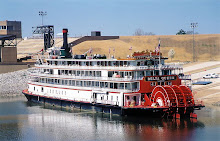
One more steamboat that has a direct connection to Ten Mile is the CLAIRTON. She was built at Ambridge Pa. in 1927 and was 147 x 33 x 6. Originally the called YOUGHIOGENY for Carnegie Steel she was later named the B. F. FAIRLESS. She came to be called CLAIRTON in 1952, being the third and last boat of that name. She ran almost entirely on the Mon till 1964 and was laid up at / near Engles Boat Docks at the mouth of the creek at Millsboro. There was hope she could be utilized locally as a museum but this never came about. While she was laid up there she had a new career as a restaurant for several years. With my family I took a few meals on that old boat . I remember that it was none too fancy but quite clean, everything wood painted white, inside and out. Guests had to ascend to the boiler ( second ) deck for seating in a small saloon. I prowled around her several times on those visits and I fail to remember her having her wheel , it may have been removed. A final chapter to the story is that in 1974 she was sold to a New Orleans company. Her engines , less boilers, were installed in the NATCHEZ, a sternwheel steamboat built new in 1975 for the day excursion trade and those same engines power her in New Orleans Harbor to this day, every day. Some old boats never die.


The CLAIRTON when she was still the B. F. FAIRLESS at the Elizabeth bridge in 1950, shoving coal as she did for 37 years.

January 4, 2009

The Monongahela River Packet Co. And A Race On The River


This is the steam packet boat ELIZABETH at Fredericktown in 1902. She was 188 feet x 35 x 5.5 and was built at Brownsville ( the hull was built at Belle Vernon ) in 1888 for the Pittsburgh - Elizabeth Pa. trade. This trade died out by 1900, no doubt because the railroad by that time went as far upriver as Brownsville. It would be 7 more years till the rails reached any farther south on the west bank. This made the Ten Mile Creek Country trade above Brownsville worth pursuing. In 1902 an independent line was formed called the Monongahela River Packet Company and ran the ELIZABETH under that flag as far upriver as Morgantown. This put her in competition with boats of the Pittsburgh Brownsville and Geneva Packet Company , the oldest and biggest company on the upper river.
In August of 1902 she and the rival company's Str. I. C. WOODWARD met below old lock # 9 and raced each other to the chamber to be the first to lock through. They must have been pretty evenly matched because they arrived at the same time , both becoming wedged in the mouth of the lock and neither could or would move for the other. Here they sat for a while until the Masters of the vessels were called and the issue resolved .


The race resulted in a tie

Which won the race is unknown but in the end the smaller company lost out to the bigger in the trade. 1902 saw the end of the Monongahela River Packet company. She was laid up later that year and in 1903 was sold and moored in the Allegheny river above Pittsburgh's 6th street bridge. In 1904 the boat next to her , the OLIVETTE , caught fire setting the ELIZABETH ablaze. She was turned loose, drifted under the Union bridge , a covered wooden structure and set it on fire . She was then pushed to the bank "where she burned at leisure".

Fire was a big enemy of these large wooden structures, dried wood, countless coats of flammable paint ( anyone who has ever worked on any riverboat, of wood or steel, can tell you that the paint is applied at every opportunity ) , kerosene lamps ( until the 1890's ) , coal or coal oil stoves, strong winds often present on the river, all made it a real possibility. Most cities had large wharf front fires at different times that would destroy many boats at once. Other very real dangers were snags ( sunken trees poking into the hull, causing some boats to sink in less than a minute ) and other sunken obstructions, boiler explosions, groundings and Pilot errors. Most all were heavily insured so when for instance, the Str. NEW ERA was sunk then usually out came the NEW ERA # 2 in a few months. Even if a boat was lost due to fire, boiler explosion or sinking, the steam engine would always be salvaged. They seem to have been virtually indestructible and were often used in several different boats over many years. Some boats lasted 20 years and many just a few years. Packet boats ran year round and tended to wear out quicker than the bigger line haul towboats which ran somewhat seasonally.

Here's the ELIZABETH at Brownsville rounding to with her stacks knocked back to clear the wooden covered bridge there. On the left descending bank is the Str. EDGAR CHERRY, a packet that ran for several years between Pittsburgh and Morgantown until she hit the gates at old lock # 4 and sunk in 1904. One can see the front end of a packet boat on the Brownsville (left) side, this is the OLIVETTE, the boat that would two years later cause the fiery destruction of the Elizabeth in Pittsburgh ( see above ) .


Here she is in the 1890's, possibly at McKeesport, Pa. It must have been some kind of holiday.


Another boat running in this trade for the Mon River Packet Company was the Str. GERTRUDE. She was fancier than most Mon River packets, with a huge pilot house not often seen up here. She was built at Hawesville Ky. in 1895 and ran on the lower Ohio before she came to the Monongahela River in 1902. Before going into the trade she was given new floors and staterooms were added. She was also given a Texas ( small deck of cabins under the Pilot house ) so likely the pilot house was altered then. The big stage seen here was likely left off as they were not much used on the Monongahela. With our steep banks a plank seems to have been sufficient for most landings, and many of the towns had stone or brick wharfs or small floating wharfboats for packets to land on. In 1903 GERTRUDE too, was sold and later ran on the Chattahoochie River in Georgia.

Str. GERTRUDE on lower Ohio 1900.

Information for this was taken mostly from Ways Packet Directory, 1848 - 1994 by Fred Way Jr. Some images are from a great site about the Elizabeth Marine Ways that includes much detail about many Mon river and Mon river built boats, Steamboat Building in Elizabeth, PA . This wonderful site is maintained by Jay W. Mohney and his efforts are a priceless addition to river knowledge.