Showing posts with label Rices Landing. Show all posts

December 1, 2009

Some People Of Ten Mile Creek Country

The East Bethlehem High School football team in 1927


Engineer Harry Wood on Waynesburg & Washington Railroad's # 9684 in 1929. The W & W was a narrow guage railroad, just 3 feet wide, so the engines and cars were all smaller than normal. That accounts for the oversized look of Mr. Wood.


Pat Fagan, UMWA Local 5 President, speaking near Brownsville. He was famed as a highly effective organizer and as a speaker. His father was a leader in the steel strike of 1892.
From Sarah Minerd Potter :
" John Phillip Wunder was born on September 30,1887,and died January 11,1948. He was a miner in Greene, Washington and Somerset counties. He married Sophie Margaret Wunder on January 29,1917. Sophie and her second child died shortly after she was born. My mom was 18 months old. John lost an eye, in the mines or not I don't know.He later became totally blind and I have his Federation of the blind cards dating back to 1938. When he couldn't see to write any more, my mom became his eyes and wrote as he dictated his poems. On the Minerd side we have had 31 deaths over the years in coal mining accidents."
John Philip Wunder in Clarksville

THE COAL MINER

The miners' lot is hard indeed.
His family often are in need
The lack of work and sickness too,
are small to what he must go through.

Few of the public ever know
a miners' risk when he must go,
down in the mines to earn his bread,
with tons of loose rock overhead.

With dim lightof his safety lamp
he works in powder,smoke,and damp,
and wades around in mud and slime'
most breathe foul air till' quitting time

And then a roar a rumbling sound
That shakes the earth for miles around
and from the shaft the flames leap high
and men are left in there to die

The agony of these poor men
can not be described by pen
as maimed and dying they await
the help they know will come to late.

No loving voice to cheer them now
no soft cool hand upon their brow
no arms to hold them as they die
no one to say a last goodbye.

They think of men who lay in pain
a week or more but all in vain
they remember how the men were found
all cold and still way underground.

They think is this to be our fate
why must our suffering be so great
they fold their arms upon their breasts
and let starvation do the rest

Think of the mother of the wife
praying for this miners' life
as hour by hour they stand above
and wait for hope from one they love.

And children cry on mothers knees
bring back my papa will you please?
and strong men turn away in grief
for they can offer no relief.

I think a miners' work is such
that he can not be paid to much,
for work he must do underground
where light of day is never found.

John Phillip Wunder
May 25,1922
photo and statement courtesy of Sarah Minerd Potter. The Minerd family has a most extensive website here


This is the first, second and third grade classes at Millsboro in 1923.


Curley Kensic had a bowling alley in Clarksville's Williamstown section. These early 1950's lady bowlers are from left to right :
Elizabeth Durdines, Dot Redman, Bonnie Conners, Clara Lamo, Dot Makel, Barbara Kolick, Ann Burke Kolick.
Photo courtesy of Elizabeth Durdines Sevec


Reader Judith Watters Adamson writes me to kindly correct the newspaper caption:
"I'm the baby shown in the photo entitled "TINY TORNADO VICTIMS", my name is Judith Watters Adamson. I was 8 months old in that picture. I have an original newspaper with this photo. The newspaper is the Pittsburgh Sun-Telegraph and the date is June 25, 1944. The caption is incorrect and should read:
Mildred Watters (not Helen) of Chartiers Hill holds baby Judith in her arms and watches over her other daughter Helen and little Diane Santucci, all victims of a tornado that struck Chartiers Pa. The Waynesburg hospital was so crowded that children had to double up in hospital beds."
Image courtesy of Ida Mary Workman Haftman
Sharpneck Motors in Rices Landing, Anson Sharpneck is third from the left. Photo courtesy of Brad Kline


Earl King remembers :
My name is Earl J. King, born Crucible, Pa 1929. I was graduated from Jefferson/Morgan High School in 1946. I lived in Rices Landing 1933 to 1959, worked in the Rices Landing National Bank, 1955 to 1959 then came to California. Now retired after 42 years of banking in Cerritos, Ca. (suburb of Los angeles).
I delivered the Pittsburgh Press daily to the Y. A. Young machine shop. Carl Young was a Mail Pouch chewer. At about age 13 or 14 I asked him for a chew of tobacco. He gave it to me and I became deathly ill. I thank him now, because I have never touched tobacco after that lesson. My father purchased a 1929 Essex Coupe from the Sharpneck Motor Company in Rices Landing. The dealership was owned by Anson Sharpneck who walked on a artificial leg. He charged us kids 1 cent to pump up our bicycle tires. He operated the Hudson/Terraplane dealership until early 1943, at which time he sold the business to his chief mechanic, Joseph Clarchick. It then became Clarchick Motor Co. I remember financing Hudson cars at the Rices Landing Bank for Joe Clarchick. The Hudson name disappeared and at my last memory it he sold American Motors Cars under the brand of Nash/Rambler. My last time in Rices Landing was May 2005. At that time the building was still standing and used as a warehouse.
Growing up in Rices Landing I remember the steam boats, W. P. Snyder, Homestead, J. B. Fairless, Vulcan and many more. I now regret that I did not take photos of the old lock #5 and all of the steam boats that traveled the Mon. I was working just across the street in Rices Landing at the bank when the Monongahela Hotel was torn down.
On the Crucible Pa Miners Memorial, the Earl King and Earl J. King listed are my dad and I. My dad was very active in Crucible Local #4721 United Mine Workers of America. As a child I remember Jock Yablonski and William (Billy) Hynes at our house on union business many times.
My grandfather, James Kelley, was killed in a slate fall in Crucible Mine 1927. My mothers brother Charles Kelley worked his entire lifetime at Clyde # 1 mine. He was a pumper at retirement.


This photo of Arthur White was taken at Clyde #1 in Fredericktown just minutes before his fatal accident

Arthur Earskin White was born in 1884 in or near Pittsburgh, the son of George H. and Helen "Ella" (Daugherty) White. He is one of a tragic many people to lose their lives in the coal, coke and steel workplace. As a young man Arthur labored on the railroad and as an electrician. Arthur married Roberta "Berdie" Estlick and by 1920, they lived at the Revere Coke Works near Uniontown, where he was a machinist in the coke plant. In 1930 the family was in Luzerne Township, Fayette County, with Arthur continuing his skill as a coal mine machinist. He played on and managed a baseball team in Hopwood.
Arthur was then employed as a machinist and master mechanic at the W.J. Rainey's Clyde # 1 in Fredericktown, due to his experience and knowledge. He was elected president of the United Mine Workers of America local union No. 688, the second person to hold that office.
In the 1930's W.J.Rainy company was strongly opposed to the fledgling Union. As punishment for his Union activities, specifically insisting the men be paid extra for working underground in water, the company moved Arthur out of the shop to a job at the river tipple. On Thanksgiving Day 1935, he was found badly injured, with a fractured skull, after being knocked into a coal barge. Some believed that coal was dumped on him on purpose by a company stooge. He died a day later at Brownsville General Hospital, at the age of 57. A newspaper article claimed that just prior to his death, Earskin had drawn his first pay in more than a year due to debts he owed to the company store.
His grandson, Lee White, remembers " The explanation given to my Grandmother and her eleven children was that he slipped. My dad believes he was killed on purpose. An interesting side note is that the company paid my grandmother $3,500 to waive her rights to future litigation. That was a lot of money at the time and uncharacteristically generous for a coal company. " His remains were laid to rest in the Hopwood Cemetery, near the final resting place of his grandparents and great grandparents. He had managed the baseball team at Clyde and was a member of the Eagles and the Moose clubs.
Arthur White was also a member of the Minerd family referred to above. A more extensive bio of Arthur is here on the Minerd site.
Clinton V. Lewis was one of seven surviving veterans of the Civil War until his death at age 92 on Nov. 28, 1939. Lewis was born at Ruff Creek but spent most of his life in Lone Pine. He enlisted as a teenager in the 18th Pennsylvania Cavalry in March 1865, near war's end. This photo, from the Harbaugh collection, was taken in 1938 at the G.A.R. encampment in Washington Pa.
Image courtesy of The Picture Box


Dorthea Boyd Johnson and her ( now deceased ) brother Sheldon Boyd at the log Stull house at Clarksville in the early 1950's. Her mothers family lived in this house in the 1920's. The Stull family had property on both sides of the north fork of Ten Mile.


Photo courtesy of Dorthea Boyd Johnson

October 4, 2009

New Website About The Area - SWPA Rural Exploration


Crucible Ferry area


Levine Building Fire In Rices Landing and that site today
It's nice to welcome a new blog about our neck of the woods. Greene County native Chip Guesman has created a site he calls SWPA Rural Exploration and describes it this way " Exploring and photographing southwestern PA's abandoned mines, industry,homes....and whatever else we may find. A little history, a little legend..... from the most massive structures to the minute details we walk past every day."
He's only had the site going for a short time but there is already a lot of great photographs of things like the coke ovens at Poland Mines, and even a video of the area at Rices Landing where one can find the Stovepipe Ghost. Watch that video to actually see things come running out of the woods ! I felt like I was watching the Blair Witch Project :). Not for the faint hearted !
I am always fascinated with urban and rural archaeological websites and I'm very happy to see one dedicated to this area. I mean heck, we've got at least as much decaying infrastructure right here as one could hope to find anywhere else !


Rices Landing Low water 1980's, All images from SWPA Rural Exploration

July 23, 2009

Ten Mile Trivia # 3

Robert Morris, a signer of the Declaration of Independence and an early official of the federal government, once owned 41,000 acres of land in Greene County. Much of his widespread acquisition of land was accomplished with borrowed money. That helped lead him into financial difficulty and eventually bankruptcy. Earlier, George Washington was the largest landowner in this section of Pennsylvania, some in Greene.
The first Boy Scout troop sponsored in Pennsylvania, it is believed, was that at Waynesburg Presbyterian Church in 1911, organized by future state governor Gen. Edward Martin.

In the late 1790s, one of the gun factories that supplied the young United States with weapons was established at New Geneva in Fayette County, shortly before the national armory was placed at Harpers Ferry, then in Virginia. However, the government competition was too much for private industry, and the New Geneva plant went out of business. The course of U.S. history would have been greatly changed had the government installation been placed at New Geneva instead of Harpers Ferry.

Former President Richard Nixon had a Western Pennsylvania heritage through his mother's family, the Milhouses, and other maternal ancestors. As early as 1795, Anthony and Lydia Smith took up residence along the south branch of Tenmile Creek near Waynesburg. Several generations of descendants lived in Greene County before the president's mother's ancestors moved westward in the mid-1800s.

An earlier version of today's illegal parking towaways was the regulation in Washington, Pa., that prohibited hitching horses to shade trees. Constables were empowered to impound the horses in public stables until a storage fee was paid.

The first telephone company to operate in Greene County was the Waynesburg and Blacksville Telephone Co., organized Jan. 20, 1887. The first two telephones were placed in the Strosnider Hotel in Blacksville and in the J.T. Rogers drug store in Waynesburg. By the spring of 1889 Jefferson, Charmichaels, Waynesburg and Rices Landing were joined by telephone. Within the next several years, several other small independent phone firms were started. Patrons on one system could not call those on another, which caused quite a bit of dissatisfaction. At one time, there were 38 different small companies within Greene County alone, all of which were ultimately merged into the South Penn Telephone Co.

A cemetery inscription at the Greene County-West Virginia border area near Blacksville reads:
"Some women have children,
And some have none,
But here lies the mother of twenty-one."


An English geologist, Sir Charles Lyall, who came to Southwestern Pennsylvania in April 1846, wrote after his study of geological formation:
"I was truly astonished, now that I had entered the hydrographical basin of the Ohio, at beholding the richness of the seams of coal which appeared everywhere on the flanks of the hills and at the bottoms of the valleys, and which are accessible to a degree I never witnessed elsewhere. The time has not arrived when the full value of this inexhaustible supply of cheap fuel can be appreciated. To properly estimate the net advantages of such a region, we must reflect how the three great navigable rivers, the Monongahela, Allegheny and Ohio, intersect it and lay open on their banks the level seams of coal. I found at Brownsville a belt 10 feet thick of good bituminous coal, commonly called the Pittsburgh seam, out in the river cliffs near the water's edge."
The accuracy of his statements has been borne out by the later appreciation of this vast coal supply and what it has meant to the area in the years since.

Sept. 30, 1939 -- Waynesburg College played Fordham at New York in the first experimentally televised football game. Although the Yellow Jackets lost, Bobby Brooks of Greensburg scored the first touchdown on TV.
In 1875, Waynesburg College President Alfred B. Miller and some of the students began the process of making bricks to build what became the main college building -- Miller Hall. Clay was obtained from a campus site and another nearby point, and three kilns were constructed on campus to "burn the brick." They were able to produce as many as 4,000 bricks daily, during which time the boys hauled "hundreds of barrels of water." Miller explained that to mold the 803,000 bricks made there "almost exhausted Ten Mile Creek for water to moisten the clay." Masons then erected the structure as money permitted, but it wasn't completed until more than a decade later.


Miller Hall courtesy of Waynesburg University

One Saturday in 1888, 11 male Waynesburg College students went to Masontown and indulged in "drinking beer and other liquors." Brought before the college faculty, they acknowledged their offenses and were allowed to remain students on condition that they sign a pledge of total abstinence.

The last survivor of Braddock's infamous 1755 defeat by the French and Indians was reputed to be one Boon Buchanan, who died in Washington County in 1846 at the alleged age of 113. He was a black man who, it was said, served as a waiter with the British army.

Lone Pine in Washington County was originally called Pleasant Valley, along the south fork of Ten Mile Creek. Twin pine trees once towered there, but one was erased by lightning shortly before a post office was established there in 1869. When the Pleasant Valley name, already in use elsewhere, wasn't available for post office use, Lone Pine was chosen.
A son of Albert Gallatin, James, supervised construction of his father's Friendship Hill mansion near New Geneva in Fayette County while the latter was in France in 1822-23. When Gallatin returned and saw the structure, he was quite unhappy with it but made the best of the situation. Shortly afterward, writing to a daughter, he described part of it this way: "The outside of the house, with its porthole-looking windows, has the appearance of an Irish barracks, whilst the inside ornaments are similar to those of a Dutch tavern."

Albert Gallatin's home, Friendship Hill
Perhaps the most significant of Albert Gallatin's accomplishments came as the result of his friendship with U.S. President Thomas Jefferson. In the early 1800s, Gallatin persuaded Jefferson to change the route of the National Road and take it through southwestern Pennsylvania. As originally planned, it would have gone around the state through Virginia ( West Virginia ).
A Greene County man is claimed to have been one of the first people in the U.S. to use natural gas for light and heating fuel. L.R. Strosnider, of Mt. Morris, shortly after the Civil War noticed gas escaping from an abandoned oil well on the property where he had a confectionery and restaurant. He placed a half-barrel over the well shaft, bored a hole in the barrel for a pipe, and ran the pipe into his building. He used this gas for cooking and frying oysters and later for light .
Zadok Cramer's 1814 book tells of a "curious cave" about a mile below Fredericktown in Washington County, along the Monongahela, called the "Panther's Den." It was described as entering the hill "about halfway from its base by a small fracture or rent in the rock. After going through a narrow or descending passage, you enter a wide but low room in which you can walk nearly upright. To the roof of this room, we found bats hanging in a stupid kind of sleep."
Near Clarksville, about half a mile upcreek from the Yablonski stone house, is a cave on the side of the high escarpment above Ten Mile Creek. This was also known as Panthers Den, likely named after the more well known one described above. Directly below it there is a large rock in the creek known as Clover Rock that was always a popular spot for fishing and swimming. This entire area is now posted as private property.

During a period of religious fervor between 1800 and 1807, a woman evangelist in the Washington-Greene border area was Rhoda Fordyce. She proclaimed "that if a person would abstain from all animal food and live on parched corn and sassafras buds ... his body would become so ethereal that he would be translated to heaven without passing through the gates of death." One man named Parker tried her theory. Instead of being "translated," he starved to death. Rhoda would not allow the body to be buried until after the third day, insisting that it would then ascend to heaven. At the end of three days, neighbors interposed and buried it. Nothing was heard thereafter of the Rhodianites, as her followers were called.


This from The Charleroi Mail of June 8, 1908 : Charmichaels Pa. In the center of prohibition Greene County (Temperance advocate) Carrie Nation today delivered her first speech since the Republican Presidential nomination. She scored the candidates. Mrs. Nation complimented the assemblage in the fact that the Merry Widow hat has not seriously inundated Greene County. In spite of the dry condition of Greene County enough ardent liquor was imported for the day to make a number of citizens loud, and the usual interruptions occurred. In a big grove 2,000 people listened to Mrs. Nation between showers. When it rained she sold her hatchets.
Last night, waiting at Rices Landing on a train, a young man lit a cigar and blew the smoke into Mrs. Nation's face. She tried to get the cigar and the young man threatened to throw her over the lock wall. The Kansas woman made an information against him before a justice of the peace, but later dropped the case.

These tidbits were taken from various books and internet sources including Robert B. Van Atta of the Greensburg ( Pa.) Tribune-Review.

April 8, 2009

Ten Mile Trivia # 2

Ten Mile Creek came to be called so because it's mouth is ten miles above Old Redstone Fort at Brownsville. In the early days they named creeks and other landmarks as being so many miles from a known place, as Brownsville certainly was in the early days. Islands also took mile marker names, for instance above Louisville Ky is 18 mile island then 12 mile island and then 6 mile island.
Some think the creek was named so because it's ten miles long. Not true, but ten miles up the creek is located the town of Ten Mile. Its Indian name is Cusuthee.
.
The very first steamboat to travel to New Orleans and return by its own power was the ENTERPRISE, designed and built in the Brownsville boatyards and launched from the Brownsville Wharf in 1814.

"Saint Barbara , the patron saint of miners, was a young virgin who defied her father and decided not to marry. Because of this he kept her in a tower. She ordered some workmen to alter the tower while her father was away, thus becoming the saint of architects. After finding out about this her father chased her to the hills where she was swallowed up by the hill. Her name is attached to Santa Barbara, California. There is a prayer for miners dedicated to Saint Barbara:
"As I now descend into the dark bowels of the earth, I beseech thee, sweet Barbara, that I be kept safe from harm, for it liketh me not that I rush unbidden into God's presence."

Wilson's Port, later called New Geneva was a very early place for freighting flatboats and rafts.The land later was patented by Elias Stone and his wife in 1787 and was called Delight.


Augustine Dillner and his wife were the first settlers in what is now Greene county.They arrived as early as 1754 and in 1755 built a cabin close to Crow's Ferry ( Dillner ). The Indians were friendly with them till Lord Dunmore's war of 1774.


"While making a tour of the United States in 1837, General Santa Anna, President of Mexico, stopped in Washington Pa.on January 15. Following the custom of the time, he probably took breakfast at Hill's Stone Tavern ( now the Century Inn ) in Scenery Hill, Pa. This was only a year after the massacre of the Texans at the battle of the Alamo, and Santa Anna was not very popular, so there was no reception committee. All known of this visit was the mere mention in the local paper, The Examiner of his passing and a well grounded tradition that a local man named Brice, whose brother had drawn a black bean ( died ) at Goliad, lay in wait just west of town to take a pot shot at the self styled "Napoleon of the West" as the stage rolled by. Fortunately for Santa Anna the sheriff heard of the plot, and, probably against his personal inclination, gathered Brice into his official fold until the Mexican was safely through Washington. Incidentally, Brice was a dead shot, and might have saved the United States much trouble nine years later if the sheriff had let him alone."

Hills Tavern now Century Inn


UMWA LOCALS
6330 Chartiers
688 Clyde
4583 Clarksville
6151 Mather
6290 Nemacolin
6310 Greensboro
4731 Crucible

6159 Bobtown
762 Vestaburg
2300 Waynesburg

UMWA Band of 4583 Clarksville Stanley Fowler Collection

One of the most notable early teachers in Fredericktown was Jonathan Knight. He was later one of the most eminent engineers of his day and became Chief Engineer of the Baltimore and Ohio railroad. He was the inventor of the coning of RR car wheels so that cars stationary on their axles can run on curved tracks without spreading the rails. He surveyed a line ( never built) for the B&O through Greene County in 1836. He lived in Centerville Pa.


Augustine Dillner and his wife were the first settlers in what is now Greene county.They arrived as early as 1754 and in 1755 built a cabin close to Crow's Ferry ( Dillner ). The Indians were friendly with them till Lord Dunmore's war of 1774.

In 1826 the Str. REINDEER was the first boat to Morgantown.

"On February 11, 1850, the first steamboat came up the Monongahela River to the little town of Fairmont. This boat was the GLOBE owned by a man named Yeager. Its appearance created a great sensation among the people, for the majority of them had never seen a steamboat, much less had one come up to their very doors. When it became known throughout the country that a steamboat was to come up the Monongahela River at daybreak on February 11, the people for miles around gathered along the banks of the river as early as the afternoon before. When the whistle of the Globe was heard down the river, the courthouse bell was rung for two hours. The people had brought lunches, so they took the day off as a holiday; speeches were made, and the new wonder examined. Many of the citizens had a free ride up the river. That day was long to be remembered." It was two years before another boat arrived.


In 1856 slackwater, meaning locks and dams, were completed up to New Geneva, making navigation possible nearly year round.

Dry Tavern was named so because in early days there was a tavern there with no liquor sold. It was on the main road leading south between Pittsburgh and Virginia. For years it was the busiest north - south road west of the mountains. The road was laid out by John Crawford and went from Pittsburgh to Finleyville, Bentleyville, Beallsville, Millsboro, Charmichaels, Willow Tree, Rosedale to Morgantown. It was planned to be 60 feet wide.

Ruff Creek got it's name from an Indian named Ruff who lived there.

The first telegraph line in Greene county was erected from Rices Landing to Waynesburg in 1861.


Southwest Pennsylvania was claimed by the districts of West Augusta, Virginia and by Westmoreland, Pennsylvania. In 1776 West Augusta became Ohio, Yohogania and Monongalia Counties, in Virginia. . Greene County in 1776 was partly ( the western slope ) in Ohio county Virginia and partly ( the eastern slope ) in Monongalia County Virginia. The court house for Monongalia was near New Geneva Pa. on the farm of Theopolis Phillips. The court house for Ohio county was at West Liberty W. Va. Virginia law directed that at each court house there was to be a pillory, a pair of stocks, a whipping post and a ducking stool ( now called waterboarding ). Only the ducking stool was used for women.
By 1780 Virginia and Pennsylvania settled their boundary dispute placing most of the Yohogania County region in Westmoreland County. In 1781 Washington County was created from Westmoreland County. Greene County was created from Washington County in 1796.


Before the big modern dams you could at times cross the mouth of Ten Mile Creek by skipping from rock to rock. Other times, because of the volume of water coming out of the creek a very large sand bar would build up there and the river channel would have to be dredged for boats to pass.

Besco is named for the Bessemer Coke Company who operated the Champion mine there using all the coal to make coke in it's 100 ovens . By 1914 there were 257 ovens, a sizable operation. The railroad reached Besco around 1911 and that was the end of track until it was extended farther through Clarksville to Mather in 1919.

In Common Pleas Court in 1797, the following case was considered : The Sheriff of Greene County wishes Richard Swan to answer the charge that he bit off a piece of John Moore's ear thereby damaging the peace and dignity of the Commonwealth.

February 25, 2009

What's Under The Ground In Ten Mile Creek Country ?

These maps give one an idea of the condition of the the ground under us and the amazing extent of mining that's gone on here. The earliest of the mines shown here were worked starting around 80 some years preceding the late 70's when this map was made. All these open to large size.


There are only a few above ground reference points shown but I think there are enough to orient one as to what is seen.


Mather Collieries, solid line at right points north. They did not mine north of the town but to the south the mine went almost to State Route 21.


This shows the area from the river roughly south to Charmichaels

maps from collection of author

February 23, 2009

Steamboat To Clarksville and Other Boats On Ten Mile Creek

There are a few documented instances of steamboats on Ten Mile Creek. The month of July in the year 1888 saw what was one of the biggest floods ever on the Monongahela. At Brownsville in that year the river crested at 43 feet, the all-time high water mark there. This was three feet more than even the great flood of 1936. On the crest of this 1888 flood the sternwheel towboat WILLIAM WAGNER ran up Ten Mile Creek and landed at Clarksville. The boat was built at Pittsburgh in 1882 and was 100 x 17 x 2 feet. This was a good sized boat, much bigger than the few steam yacht / pleasure boats that are known to have travelled up our creek. There would have been no bridges to deal with at that time until they reached Clarksville, a little less than three miles from the river. Judging by the configuration of the creek it must have been some hard shoving once up to the area where Pitt Gas and Besco would later be. The vessel was owned By Capt. J. C. Cooper ( called Clinton by his friends ) and Levi Barker. Capt Cooper was in command on this trip. What business they had there, if they had a barge in tow or where at the town they landed is unknown. At that time some towboats running in backwater trades also carried a limited number of passengers, even a small 60 foot boat could be registered for 5 cabin and 5 deck passengers. It is possible too, that they did it just for bragging rights as that was sometimes done by these early rivermen. According To Capt. Way's Steam Towboat Directory the boat was " principally remembered as towing timber out of the Upper Monongahela to boatyards and elsewhere." She was out of documentation ( no longer operating ) in 1890. No photographs of her exist. Capt. Cooper's daughter, Mrs. Phil Kussart, is the author of a river history book titled " The Allegheny River . "

Another boat that visited Clarksville on a flood was the little steam propeller yacht GAZELLE. Nothing is known of either her business or the year she went up. She was 65 x 10 x 3 and built by R. C. Price at Allegheny ( now the North Side of Pittsburgh ) Pa. in 1901. At that time she was owned By Harrison P. Dilworth and other Greene County businessmen who had coal properties on the upper Monongahela. On the trip to Clarksville she was under the command of Capt. John S. Faddis who was, I believe, from the Rices Landing area. He was a riverman of some versatility. In 1905 Capt. Faddis was Master of the ROSE HITE, a large ( 155 x 28 x 4 ) Mon river packet boat that ran the upper Mon. He was at the wheel when she collided with the towboat JOHN F. KUEN above Brownsville and sank with the loss of 5 Black deckhands. He also ran the small DAISEY, a " daylight short trader " , between Martin Pa. and Morgantown early in the century. She was a little sternwheel packet , 75 x 14 x 2 with one boiler that was 54" x 7 feet, built at Antiquity Pa. in 1903. Originally built by Capt. E. E. Varian, she was later owned by H.E. and T. B. Eberhart. In 1908 she was sold to Capt. William Goudy of Rices landing and in 1911 she was sold down the Ohio River. No photo known to me exists of this boat. The GAZELLE probably looked somewhat like the HAZEL L. WATSON in the picture below.


This photo shows the little propeller steamer HAZEL L. WATSON running between East Millsboro and Millsboro with the Mouth of Ten Mile Creek in the background. This photo was taken after 1907 since we see the RR bridge across the creek's mouth. This is an old real photo post card view that I bought years ago and likely one of a kind as those often are. The writer of this card describes it as "the ferry", more accurate would be the old term packet boat or the modern term water taxi. It is likely to assume that she made occasional trips into Ten Mile, water permitting. She was built at Allegheny Pa. in 1901 and was 70 x 10 x 3. Owned by Capt. John O. Watson in 1907, Capt. William Syphers of Rices landing bought part interest and owned her outright by 1909. Syphers, who owned the Monongahela Hotel in Rices Landing, ran her between Brownsville and Rices Landing. Later owned by Crosan Construction of Brownsville , she was lost on Feb. 10, 1918 in the big ice of that year , at Rices Landing.
Ten Mile Creek did, and still does put out quite a volume of water. In old times before the new locks a bar would build up running across the river at the creek's mouth and had to be regularly dredged so that boat traffic could pass up and down.

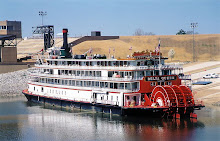
One more steamboat that has a direct connection to Ten Mile is the CLAIRTON. She was built at Ambridge Pa. in 1927 and was 147 x 33 x 6. Originally the called YOUGHIOGENY for Carnegie Steel she was later named the B. F. FAIRLESS. She came to be called CLAIRTON in 1952, being the third and last boat of that name. She ran almost entirely on the Mon till 1964 and was laid up at / near Engles Boat Docks at the mouth of the creek at Millsboro. There was hope she could be utilized locally as a museum but this never came about. While she was laid up there she had a new career as a restaurant for several years. With my family I took a few meals on that old boat . I remember that it was none too fancy but quite clean, everything wood painted white, inside and out. Guests had to ascend to the boiler ( second ) deck for seating in a small saloon. I prowled around her several times on those visits and I fail to remember her having her wheel , it may have been removed. A final chapter to the story is that in 1974 she was sold to a New Orleans company. Her engines , less boilers, were installed in the NATCHEZ, a sternwheel steamboat built new in 1975 for the day excursion trade and those same engines power her in New Orleans Harbor to this day, every day. Some old boats never die.


The CLAIRTON when she was still the B. F. FAIRLESS at the Elizabeth bridge in 1950, shoving coal as she did for 37 years.

November 26, 2008

Steamboat Gallery # 1

No steamboats ran regularly on Ten Mile but they ran right past and besides that ........ I love a steamboat. For about 80 years the easiest and cheapest way to get from Ten Mile Country to the big city ( Brownsville or Pittsburgh ) was to take the packet boat. There were actually only two choices, a mud road or the packet boat until the railroad was extended from Brownsville through Fredericktown to Rices Landing ( completed Jan.9,1908 ) and the branch to Besco, in late 1907. Many towboats and packets were seen every day from the banks and people knew them even at night by the distinctive sound of the whistle.
Here are just a few vessels that were very well known to people on our stretch of the Mon.

The Clyde Coal Co.'s very pretty towboat. Imaginatively, she was named CLYDE
. This company had the mine of the same name in Fredericktown. Built at Rochester in 1903, she ran the Mon until 1930.


The Str. JAMES E. LOSE was one of many Carnegie Illinois Steel Co. boats. Later, these boats that ran locally (in the pools between the dams) were called pool boats , were operated under the U S Steel name and the " line haul boats ", which ran down the Ohio and Mississippi Rivers became Ohio Barge Line ( 1941- 1985). When I started at OBL in the mid 1970's many of the Mates, Pilots and Captains that I worked with had been deckhands and Mates on these Carnegie Steel boats.
In 1945 there were as many steam sternwheel boats operating as there were diesel boats. In 1949 there were still 42 sternwheelers ( J&L alone had eleven of them ) running on the Allegheny Mon and upper Ohio. By 1953 there were 10, five owned by US Steel, Consol Coal and Crucible each still operated two and Ohio Barge Line still had one sternwheeler working. OBL 's last steamboat, a steam propeller vessel, ran until 1963. History is not that far behind us, just look over your shoulder and there it is.


This is the Str. La BELLE of the Wheeling Steel Corp. downbound at Fredericktown.


The CHARLES R. COX of US Steel downbound at Rices Landing. Her roof bell is now on display at the Monongahela River Buffs Museum


The Str. ADAM JACOBS at Brownsville in 1895. Owned by the Pittsburgh Brownsville & Geneva Packet Co. she regularly ran between these places. She was built at Brownsville in 1885.
This was one huge boat, over 200 feet long. Click on the pic and it will enlarge to actual size.......... just kidding.

The W.P.Snyder Jr. at Marietta

Fortunately for us there is a wonderfully preserved example of a Monongahela River towboat at Marietta Ohio. The Str. W.P. SNYDER JR. is docked there at the Ohio River Museum. The museum has a large and fine collection of river artifacts but their jewel is this vessel. She is exactly as she was in the old days and you can wander over her at your own pace and see how they lived and worked on the river on this Carnegie Illinois and later Crucible Steel owned boat. I'm glad they saved one of these unique vessels, she is the only surviving coal-fired, steam-powered sternwheeler towboat in the US not to mention the only pool boat. The smoke stacks on all the pool boats were made to be tilted back to clear low bridges and the pilot house was built on the forward end of the cabin rather than on top of the roof. They evolved to fit the needs of the river and locks in terms of power, size and draft. In the late 70's my wife and I first visited this boat at the museum. When I returned to work I was on the boat with Captain Leon Lyle of Pittsburgh, originally from Paducah, Ky. I had worked with him when he was a mate and he was of the old school and was as good a boatman as could be found on the river and I learned much from him. I was talking about how fascinating it was to visit the SNYDER. he said to me " I know that boat very well, I spent 10 years as Mate on her, just like you are Mate on here for me now. " For a complete description refer to her National Historic Landmark Nomination here.

Starboard Engine


The galley, not a lot of space to prepare food for 12 - 15 people.


The Str. W. P. SNYDER JR. was originally built as the Carnegie Steel Co. towboat W. H. CLINGERMAN in 1918 by Rees of Pittburgh, Pa. In 1938 she was renamed J. L. PERRY and in 1945 she was sold to Crucible Fuel Co. and again renamed as the W. P. SNYDER Jr. She towed coal on the Monongahela river for 35 years until she was laid up on September 23, 1953 at Crucible, Pa. In the summer of 1955 she was given to the Ohio Historical Society for exhibit at the Ohio River Museum of the Sons and Daughters of Pioneer Rivermen in Marietta, Ohio.


November 21, 2008

Jefferson


Jefferson Main Street 1866


Likely near the covered bridge at the railroad underpass. W.T. Hays was a photographer from Waynesburg who did a lot of work around Greene County.


This old Post Office was across the street from the present one. Jefferson's first Post Office was established in 1805.


From the History Of Education in Pennsylvania by J. P. Wickersham, 1886 : In the little town of Jefferson, Greene county, the Baptists of Southwestern Pennsylvania founded an institution of learning, in 1867, which was chartered under the name of Monongahela College, in 1871. The grounds consist of fourteen acres, and the buildings are comfortable though small. The endowment is $30,- 00O. Creditable progress has been made in securing apparatus and a library. The College admits both sexes, and several ladies occupy places in its faculty. The students number about seventy- five, only a few of whom are in the regular College course. Rev. H. R. Craig has been President from the first.The college did not make it long as a business and folded in the 1890's. In 1909 the Jefferson High School moved into the building.It was torn down in 1956.

Clicking this image opens a nice large map from Caldwells Atlas 1876


List Of Business 1876


Jefferson looking south, undated photo

Jefferson at one time had around 700 citizens. There was a grain mill, several tanneries, saddle shops,cooper shops, wagon maker shops, five saloons. It was a busy distributing center for the country trade. The Jeffersonian and Jefferson News delivered the latest news. It was often spoken of as the best place for the county seat, being on the main road between Rices Landing and Waynesburg, the two most important towns in the county. Colonel James Maxwell, a very prominent officer in the Revolution, is buried in the Presbyterian cemetery. When slack water was carried above Rices Landing and the Waynesburg & Washington Railroad was built to Waynesburg then the importance of Jefferson waned.

Rice's Landing


The Str. I.C. WOODWARD, well known Mon River packet at the wharf in 1912

Old Lock #6 at Rices Landing. The original lock was completed in 1856. The Engineers did a major overhaul in 1902 and this image was made after that.


images collection of the author
This is where you will find the W. A. Young & Sons Foundry and Machine Shop. It is a real treasure in this area and everyone should visit it at least once. When I walked in there I felt as though I had just stepped out of a time machine. The W.A. Young Foundry has been called “the greatest find of its type in the nation” by the Smithsonian Institute’s curator emeritus. Built in 1900, this foundry and machine shop cast numerous items from horseshoes to locomotive wheels.

The Str. COLUMBIA downbound at Rices Landing.


Dilworth Mine Tipple at Rices Landing.

The Dilworth Mining Company (1880-1930) was the first major commercial coal mine in Greene County, It was a deep shaft mine and had 190 coke ovens and was located along the river on the northern border of Rice's Landing. Coal and coke were loaded directly into barges from the riverside mine.
In 1914, the Rice's Landing Coal and Coke Company acquired the Dilworth Mine. Within the next few years, the H.C. Frick Coke Company acquired the mine and many of the lots in Rice's Landing including two blocks between Second Street and the ferry landing.It was reopened in 1974 by U.S. Steel, and purchased by Consolidation Coal Co. in 1984.

This opens to a fine large map from Caldwells Atlas of 1876

List Of Business Rices Landing 1876


From The Monongahela Directory of 1859

John Swan tomahawked a claim in 1767 at what is now Rice's Landing. He, Jesse Vanmeter and Thomas Hughes built a fort about a mile south of Rice's Landing in 1768. The patent for the land above the run was given to John Rice and he laid out that part of the town as Newport grew. It was founded in 1780 when John Rice obtained a Virginia certificate for a 389-acre tract of land southeast of Pumpkin Run, then known as Enoch's Run. In 1786, Rice patented the land; and the town of Newport was laid out. Abijeah McClain and Pamela Doughty patented the lands to the northwest of the run where the town of Rice's Landing developed in the early 19th century. When the first post office was set up there it was given the name Rice's Landing. Until 1903, Rice's Landing and Newport remained as separate communities divided by the Cumberland and Jefferson Township line but connected by a covered bridge over Pumpkin Run. A later iron bridge was replaced in 1914 with the extant concrete deck bridge.
Even before improvements were made to the Monongahela River's navigation system, a prosperous packet trade operated on the river. By the 1830s, large keelboats and occasional steamboats docked at Rice's Landing where warehouse space provided storage facilities for goods. From the town's dock, Daniel Montgomery commanded a flatboat that was enrolled at the Pittsburgh Customs House in January of 1832. Joseph Sedgewick and his son, Samuel, were prominent traders who operated small steamboats on the Monongahela River when navigation conditions permitted. Sedgewick owned stores and warehouses at Rice's Landing. Unreliable seasonal navigation on the Monongahela River interfered with steamboat and keelboat travel until the improved canalization of the river by the Monongahela Navigation Company. When the locks were completed in November of 1856, a lock keeper was stationed at Rice's Landing to collect tolls. A ferry operated by the Hughes family crossed the Monongahela River at the north end of town providing access to Fayette County and Brownsville.

Rice's Landing was a key riverport on the Upper Monongahela River and served as the distribution point for all of northeastern Greene County including Waynesburg and Jefferson. By 1859 it was described as a "thriving settlement" owing "its present prosperity to the slackwater and its facilities as a shipping point. " The first telegraph line in Greene County, strung in 1861, ran from Rices Landing to Waynesburg.
During the era when it was a booming river town, lines of horse-drawn wagons and hacks would be strung out along the uphill road as far back as Dry Tavern, while the drivers awaited a turn to unload and reload. It was said that more business was transacted in Rices Landing in one day than transpired in Waynesburg in one week. Rices Landing flourished with two livery stables, cooper shops, blacksmith shops, boot stores, general stores, grist mill, planing mill, a machine shop, stone and pottery works, photo shop, sign painters, millinery shops, dress and hat shop, freight haulers, a greenhouse, a drugstore and three hotels. It is estimated that at one time there were 2,000 residents.


Monongahela House Hotel, undated, courtesy of Brad Kline
The Monongahela Hotel was for a many decades the trading and economic center of Greene and parts of Washington County. It was the place of choice for packet boat men, passengers, drummers (salesmen), traders and travelers of the era. The first floor of the old hotel, fronting on Main Street just opposite the U. S. River Lock No. 6, was for many years known as the Monongahela Commission House, where barrels of salt, sugar, flour were traded for hides, whisky, livestock, etc. Old ledgers kept by Linsey Hughes, a Commission House agent, reveals that almost all transactions were made by the barter system, with goods but not much money changing hands.
The famous lodging and trading place was built in 1840 by a group of influential citizens. Among those believed to have been part owners in the Monongahela House Corporation were Isiah Faddis, who was an early day hotel keeper, and Capt. J. Randolph Hewitt, a Civil War Veteran who operated a dry goods store in the building. In the early 1900's Capt. William Syphers owned the hotel. He also ran a small packet boat, the HAZEL L. WATSON between the town and Brownsville. The last owners were James Walton and Samuel Smith, who was an attorney in Waynesburg. In the fall of 1957 the 20-room, three story building, by then sagging and decrepit, was torn down. Only the steps still remain.


In 1870 local school teacher Isaac Hewitt, Jr. established the Excelsior Pottery Works where he produced gray salt-glazed stoneware distinguished by his "Rice's Landing" trademark. Hewitt's pottery was the most profitable company outside of the Greensboro and New Geneva stoneware center located upstream. The company annually produced 45,000 gallons and employed six workers who operated three wheels. Hewitt marketed part of his merchandise through agents while the remainder was sold from wagons by the proprietor. After a decade of success, production was reduced and the annual value dropped from $6,500 to only $2,000 in 1880. As navigation to the Greensboro and New Geneva pottery centers improved, Hewitt's pottery experienced competition for downriver trade, a factor that was most likely responsible for the pottery's demise around 1885. The pottery was later used as a residence and is still extant.

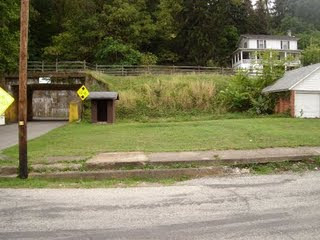
If you really know Rices Landing then you know just where to roll the car window down and yell " Stovepipe ."

This comment was left on a paranormal website discussing The Rices Landing Stovepipe ghost :
Train Tunnel Legend and locals claim on a rainy night a young boy in the 1800's was driving his horse and buggy over railroad tracks to take a short cut when the train came and collided with the buggy, the boy's head was severed and his body found a piece of stove pipe which it placed where his head would be, now on rainy nights after dark if you walk the tracks and call "Stove Pipe" three times his ghost will appear to you. Below is a follow up comment intended to correct the above statement:
The Stovepipe Ghost is not at the tunnel into Pumpkin Run Park. The train over that tunnel last ran in the 1930's, and nobody could drive a buggy over it because it was too narrow. There is a road called Horse Shoe Bend directly up from the tunnel. In the early 1900's a man was coming down Horse Shoe Bend in his horse & buggy when the buggy overturned and the mans head was cut off by the wheel of his wagon. When some men from town went to retrieve the body they said his neck was so flattened out that it resembled a stove pipe. About a year later, on the same road, a person was traveling by and thought he saw the headless body laying along side the road. Later the myth about Stovepipe began. If you go up Horseshoe Bend and stand at the 'bend' and say 'Stovepipe, Stovepipe, I found your head!' You can hear Stovepipe come up the embankment. The tunnel myth was started by some kids who have no knowledge of the town.
If you go under the tunnel and into Pumpkin Run Park and follow the road back then go across the creek, you will see a pile of cut stones. about 100 years ago there was a town back there called 'Casebear Hollow' and there was a stone quarry, a rock dust mill, as well as 10 houses. The stone quarry is a place where a lot of strange happenings have occurred. Its been said that sometimes you can hear eerie flute notes coming from near the quarry, and rumor has it that there is a flight of stairs that take you under the quarry and there are supposed to be some kind of evil things that live there. Further back in the park is a place called 'Mooney Rocks' where someone fell to their death from them. If you follow the creek you will eventually find yourself near the foundation of an old grist mill where the body of a murdered young girl was found....... How do I know these things? I've lived here for almost 65 years. Just be careful when you come here exploring."


There is a small general site about Rices Landing, I can recommend a page of theirs , one of nice and rare old photos, here.